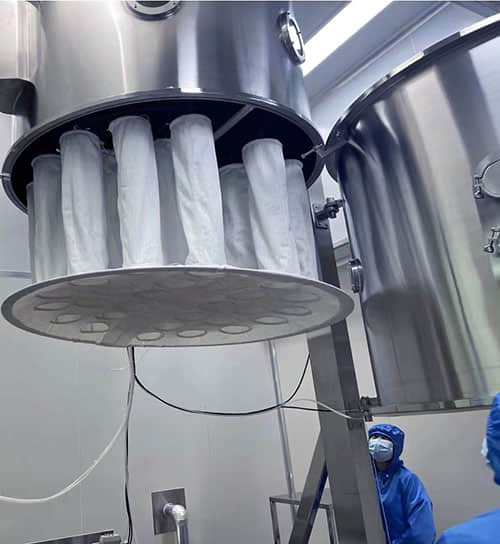
Pharmaceutical Powder Processing Equipment & Jet Milling Solutions
Pharmaceutical powder processing requires more than selecting a mill. The material, target particle-size distribution, batch size, temperature sensitivity, contamination limits, cleaning method and containment requirements all influence the final equipment configuration. JETER develops jet milling and integrated powder-processing solutions around these project conditions.
Pharmaceutical Powder Processing Challenges
- Controlling D50, D90 or D97 while limiting oversized particles
- Processing heat-sensitive APIs and intermediates
- Reducing contamination from product-contact components
- Supporting practical cleaning, batch changeover and traceability
- Containing fine dust and integrating closed feeding and collection
Recommended Equipment
| Process requirement | Typical equipment route | Selection focus |
|---|---|---|
| API or excipient micronization | Jet mill or fluidized-bed jet mill | Target PSD, temperature sensitivity, purity and capacity |
| Small-batch evaluation | Laboratory jet mill | Sample quantity, scale-up data and product recovery |
| Fine classification | Air classifier | Cut point, top-size control and circulating load |
| Powder blending | Powder mixer | Uniformity, bulk density, cleaning and batch size |
| Closed material transfer | Vacuum feeder | Dust control, conveying distance and receiver design |
Typical Materials and Particle-Size Goals
Typical projects include APIs, pharmaceutical intermediates, excipients, inhalation-powder components and selected heat-sensitive formulations. The achievable particle size and capacity depend on the material's hardness, feed size, moisture, cohesiveness and required product recovery. Published ranges are only preliminary references; laboratory or pilot testing is recommended when the specification is critical.
How Pharmaceutical Jet Milling Works
Compressed process gas accelerates particles inside the grinding chamber. Particle-to-particle collision reduces size without conventional grinding media. In a fluidized-bed system, a dynamic classifier returns oversized particles to the grinding zone while qualified fines leave the system. Gas type, pressure, classifier speed, feed rate and collection design are selected around the material and target PSD.

Information Needed for Equipment Selection
- Material name, SDS and pharmaceutical application
- Current feed size and required D50, D90 or D97
- Required batch size or hourly capacity
- Temperature sensitivity, moisture and bulk density
- Product-contact material and contamination limits
- Cleaning, containment, documentation and automation expectations
- Available compressed-air or nitrogen conditions
Arrange material testing and process evaluation before final equipment selection.
Related Pharmaceutical Powder Equipment
- Jet mills for micronization
- Laboratory jet mills for trials and small batches
- Air classifiers for fine-powder separation
- Powder mixers for downstream blending
- Drying equipment and granulation equipment
Frequently Asked Questions
What particle size can a pharmaceutical jet mill produce?
The result depends on the material and operating conditions. JETER uses the target D50, D90 or D97 together with test data to select the mill and classifier configuration.
Can jet milling handle heat-sensitive pharmaceutical powders?
Jet milling can be suitable because expanding process gas limits temperature rise, but material-specific testing is still required for critical products.
When is a laboratory test recommended?
Testing is recommended when the required PSD is narrow, the material is costly or cohesive, contamination limits are strict, or scale-up capacity must be estimated.
Can the system use nitrogen?
Inert-gas configurations can be evaluated for materials that require oxygen or moisture control. The final design depends on the material safety data and site requirements.
Does JETER provide a complete processing line?
JETER can configure feeding, milling, classification, collection, conveying, mixing and controls as an integrated system according to the project scope.
Request a Pharmaceutical Powder Processing Proposal
Send the material name, feed size, target particle size, required capacity and cleaning or containment requirements. Our engineers will review the process route and recommend suitable testing and equipment options.
Contact JETER for pharmaceutical jet mill selection and a customized proposal.