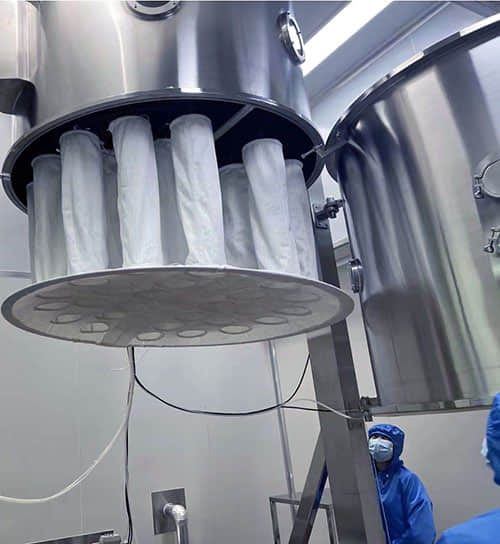
Advanced Material Powder Processing Equipment
Advanced materials require powder-processing equipment selected around particle-size distribution, purity, hardness, abrasiveness, atmosphere sensitivity and scale-up requirements. JETER develops milling, classification, mixing and closed powder-handling solutions for ceramic, mineral, electronic and functional powders.
Send your material data, target PSD, purity limits and capacity for an initial engineering review.
Typical Advanced Materials
- Alumina, zirconia, silicon carbide and functional ceramics
- Silica, graphite and selected mineral powders
- Electronic materials and conductive additives
- High-purity inorganic and composite powders
- Research, pilot and production-scale functional materials
Recommended Equipment Routes
| Process goal | Equipment | Selection focus |
|---|---|---|
| Ultrafine grinding | Fluidized-bed jet mill | Target PSD, purity, gas demand and wear |
| Laboratory evaluation | Laboratory jet mill | Sample quantity, recovery and scale-up data |
| Precise separation | Air classifier | Cut point, top-size control and fines management |
| Powder blending | Powder mixer | Bulk-density difference, uniformity and wear |
| Closed transfer | Vacuum feeder | Dust control, contamination and conveying route |
Particle-Size Distribution and Purity
D50 alone does not describe an advanced powder. D10, D90, D97, oversized particles, fines, agglomeration and morphology may affect downstream performance. Product-contact materials and wear-resistant components should be selected against the material and permitted contamination level.
Atmosphere and Process Integration
Moisture- or oxygen-sensitive materials may require sealed feeding, nitrogen operation, controlled collection and protected discharge. The final system can combine feeding, jet milling, classification, collection, mixing and automation. Safety controls must follow the material safety data and site standards.
Questions for Equipment Selection
- What is the material chemistry, hardness and abrasiveness?
- What are the feed size and target D10/D50/D90/D97?
- What capacity is required at laboratory, pilot or production scale?
- What metallic or other contamination limits apply?
- Are nitrogen, moisture control or closed-loop operation required?
- What downstream mixing, coating or handling steps follow?
Use laboratory or pilot testing to validate fineness, capacity and contamination risk.
Related Advanced-Material Equipment
- Fluidized-bed jet mill
- Laboratory jet mill
- Air classifier
- Powder mixers
- Battery-material powder processing
Frequently Asked Questions
How is contamination controlled during ultrafine grinding?
The process route, product-contact materials, liners, operating conditions and cleaning method are selected according to abrasiveness and purity limits.
Why is pilot testing important?
Testing provides evidence for achievable PSD, capacity, product recovery, gas demand, wear and scale-up behavior before production equipment is sized.
Can the system operate under nitrogen?
Inert-gas systems can be evaluated for materials requiring moisture or oxygen control. The configuration depends on the safety data and process specification.
Can JETER integrate classification and collection?
Yes. Milling, classification, collection, conveying and controls can be engineered as one powder-processing system.
Request an Advanced-Material Process Evaluation
Provide the material, feed size, target PSD, capacity, contamination limits and atmosphere requirements for a preliminary route recommendation.
Contact JETER for advanced-material powder equipment and testing options.