Powder Processing Solutions by Industry
JETER designs powder processing equipment and integrated systems around the material, target particle size distribution, capacity, purity, cleanability and production environment. Explore our solutions for pharmaceutical, battery, chemical, food and advanced-material applications.
Pharmaceutical & API Micronization
Pharmaceutical powders often require repeatable micronization, low contamination, controlled temperature and practical cleaning. JETER evaluates the API or excipient, feed size, target D50/D90, batch size, containment level and material-contact requirements before recommending a system.
Typical materials and process goals
APIs, pharmaceutical intermediates and fine excipients
Narrow particle size distribution and improved dissolution performance
Low-temperature, low-contamination processing
Batch traceability, cleanability and optional closed handling
Recommended equipment: jet mill, laboratory jet mill, air classifier, mixers and closed powder conveying systems.
Discuss pharmaceutical material testing and process design
Battery Materials & Solid-State Batteries
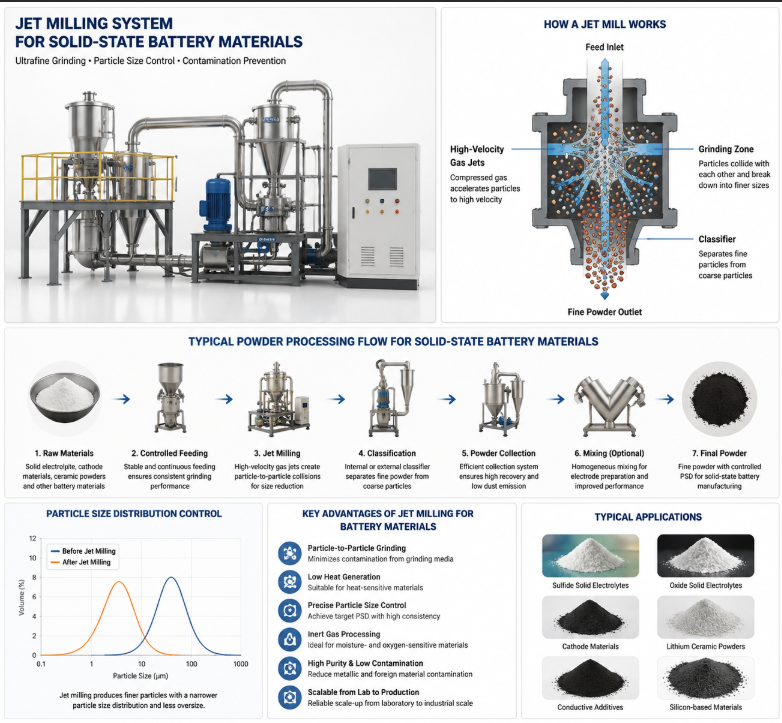
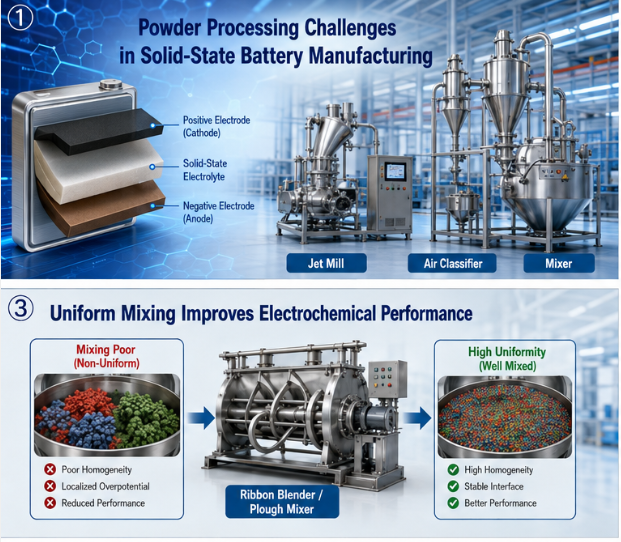
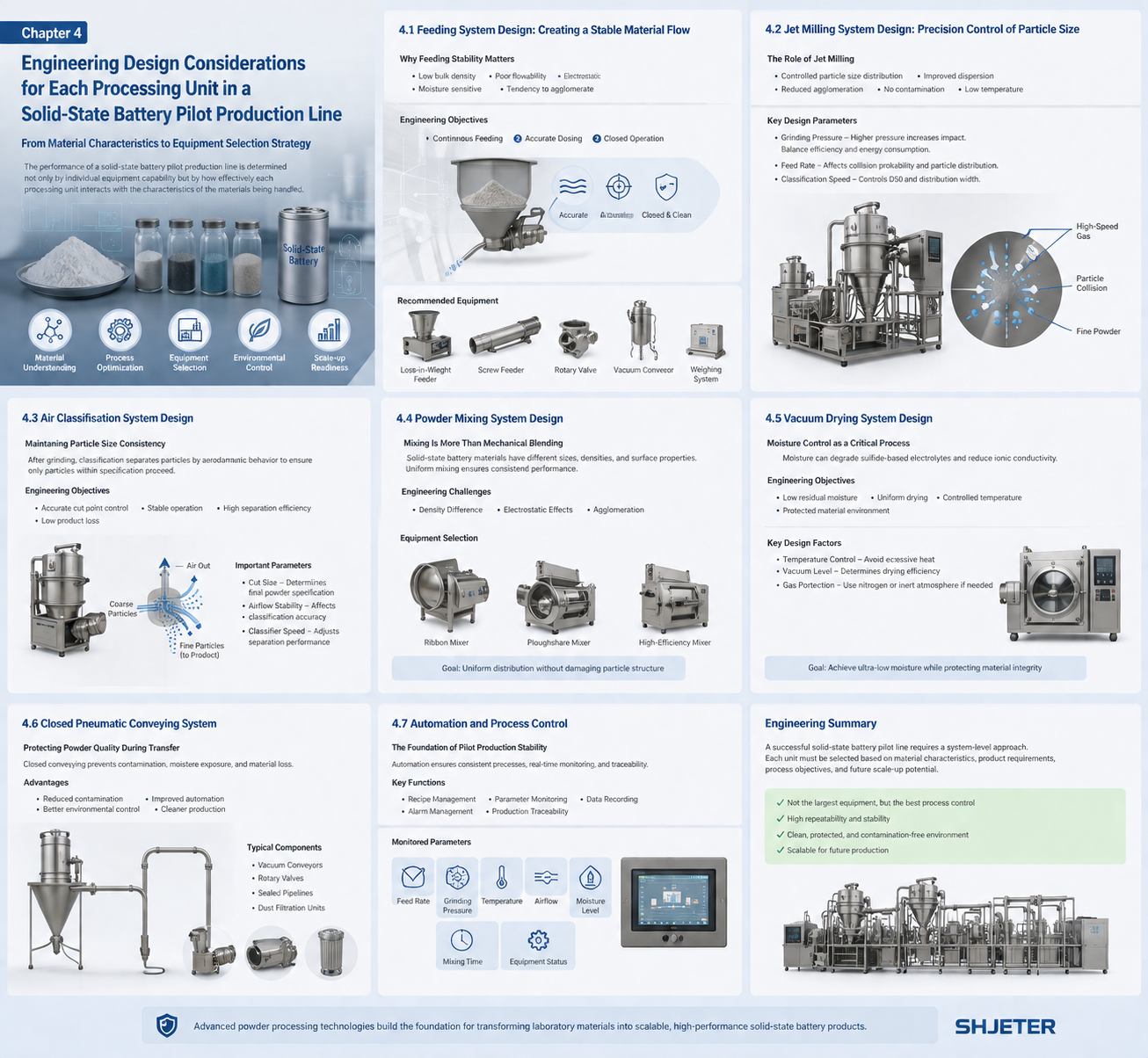
Battery and solid-electrolyte powders can be sensitive to moisture, oxygen, heat and metallic contamination. Equipment selection should consider the complete process from sealed feeding and micronization to classification, collection and discharge.
Typical materials and process goals
Solid electrolytes, cathode and anode materials
LFP, conductive additives and lithium-containing ceramics
Controlled D50/D90/D97 and minimized oversized particles
Optional nitrogen protection, ceramic lining and closed-loop processing
Recommended equipment: fluidized-bed jet mills, air classifiers, laboratory test systems, mixers and inert-gas powder processing lines.
Read the solid-electrolyte jet milling guide
Chemicals, Pigments & Specialty Powders
Fine chemicals and specialty powders vary widely in hardness, abrasiveness, moisture content, explosibility and temperature sensitivity. JETER matches the grinding, classification and collection route to the material behavior and final product specification.
Typical materials and process goals
Pigments, dyes, resins, catalysts and agricultural chemicals
Consistent fineness and narrow particle size distribution
Wear control, dust containment and stable continuous output
Process integration with mixing, drying or granulation
Recommended equipment: jet mills and mechanical mills, air classifiers, ribbon mixers, dust collection and complete grinding-classification systems.
Send your chemical powder requirements
Food, Nutraceutical & Natural Products
Food and nutraceutical powders require hygienic material contact, practical cleaning and reliable control of fineness and mixing uniformity. The suitable process depends on oil content, moisture, heat sensitivity, bulk density and target throughput.
Typical materials and process goals
Spices, sugar, starch, plant powders and food additives
Nutritional ingredients and selected natural extracts
Uniform grinding, mixing, drying or granulation
Stainless-steel construction and dust-controlled operation
Recommended equipment: universal mills, jet mills, powder mixers, dryers, granulators and conveying systems.
Plan a food powder processing line
Ceramics, Minerals & Advanced Materials
Ceramic, mineral and functional powders may demand ultrafine grinding, accurate classification and careful wear-material selection. Pilot testing helps determine achievable fineness, capacity, energy use and contamination risk before scale-up.
Typical materials and process goals
Alumina, zirconia, silicon carbide and functional ceramics
Silica, graphite, mineral powders and electronic materials
Removal of oversized particles and stable powder consistency
Wear-resistant construction and scalable process parameters
Recommended equipment: jet mills, mechanical mills, air classifiers, mixers and integrated fine-powder collection systems.
Request an advanced-material process evaluation
How JETER Develops an Industry Solution
Material review: material name, feed size, bulk density, moisture, hardness and safety data.
Target definition: required D50/D90/D97, capacity, purity, temperature and atmosphere limits.
Testing and selection: laboratory or pilot testing where needed, followed by equipment and process selection.
System engineering: feeding, milling, classification, collection, mixing, drying, controls and plant-layout integration.
Manufacturing and support: fabrication, FAT, installation guidance, commissioning and operator support.
Start Your Powder Processing Project
For a useful first evaluation, send the material name, current feed size, target particle size, required capacity, product-contact material, purity limits and any GMP, inert-gas or explosion-protection requirements.
Contact JETER for equipment selection and a customized process proposal