Jet Mill Manufacturer for Ultrafine Grinding
Jet Mill for Ultrafine Powder Processing
Product Introduction
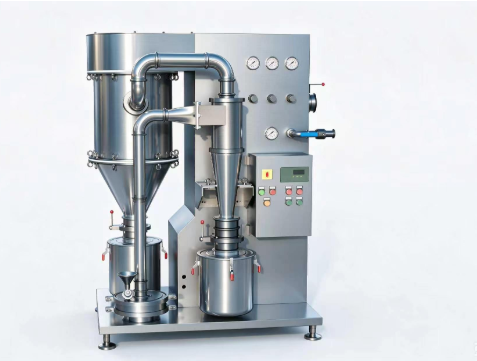
JETER Jet Mill is an ultrafine grinding system designed for applications requiring precise particle size control, high product purity and low contamination.
The mill uses high-velocity compressed air or process gas to accelerate particles and achieve size reduction through particle-to-particle collision. Unlike conventional mechanical mills, no grinding media are required, helping reduce wear-related contamination and making the technology suitable for high-value powders.
JETER Jet Mills are used for pharmaceutical and API micronization, chemical and specialty powders, battery materials, food ingredients, minerals and advanced materials.
For applications with specific D50, D90, capacity or purity requirements, material testing can be carried out to determine the appropriate Jet Mill configuration.
Key Advantages
Ultrafine Grinding
Designed for fine and ultrafine powder processing where controlled particle size is required.
Low Contamination
No conventional grinding media are used, reducing the risk of contamination caused by media wear.
Precise Particle Size Control
Grinding conditions can be adjusted according to material characteristics and the required particle size distribution.
Low-Temperature Processing
The grinding mechanism avoids direct mechanical grinding contact, making Jet Milling suitable for many temperature-sensitive materials.
No Grinding Media
Particle size reduction is achieved primarily through high-velocity gas flow and particle-to-particle collision.
Compact Design
A compact grinding configuration simplifies installation, operation and routine maintenance.
Flexible Gas Selection
Compressed air can be used for general applications, while nitrogen or another suitable inert gas can be considered for oxygen-sensitive materials.
How Does a Jet Mill Work?
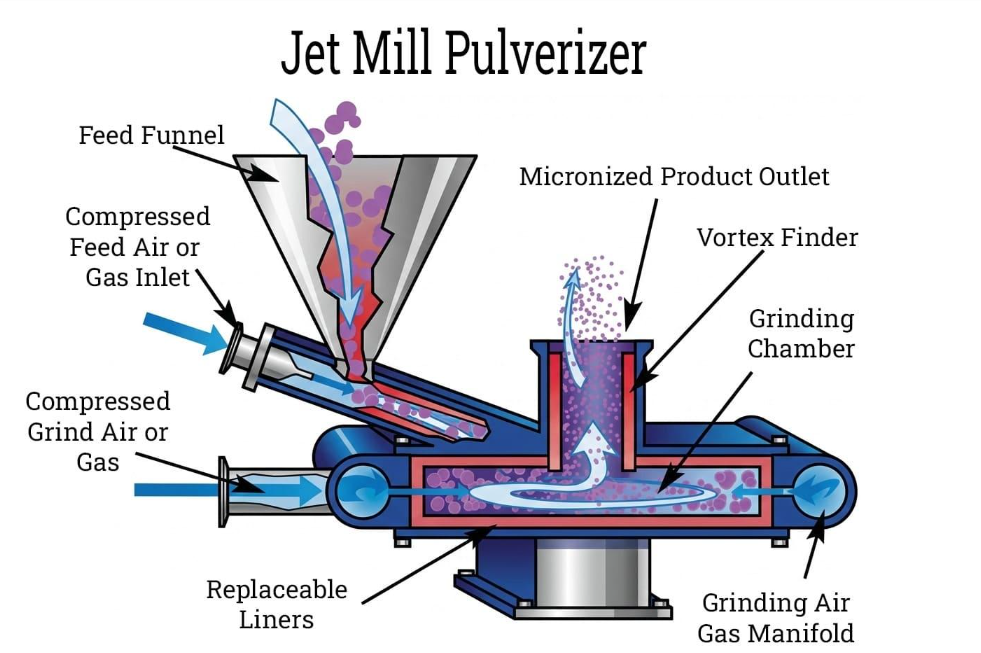
A Jet Mill uses high-velocity compressed air or process gas to reduce particle size inside a grinding chamber.
Feed material enters the grinding chamber through a controlled feeding system. High-pressure gas is introduced through specially designed nozzles, generating high-velocity gas streams that accelerate the particles.
The accelerated particles collide with each other repeatedly. These particle-to-particle impacts cause the particles to fracture and progressively reduce in size without grinding media.
Fine particles are carried out of the grinding zone with the gas flow, while coarser particles remain in the grinding area for further size reduction.
The final grinding performance is influenced by:
Grinding gas pressure
Gas flow rate
Feed rate
Feed particle size
Material hardness and density
Material moisture
Target particle size
Classification conditions
For critical applications, JETER recommends material testing before final equipment selection.
Particle Size Control
Particle size in a Jet Mill is controlled by the interaction between material properties and operating conditions.
Key factors include:
Grinding Pressure
Influences particle acceleration and collision intensity.
Gas Flow
Affects particle transport and separation within the grinding system.
Feed Rate
Influences particle concentration and grinding efficiency.
Feed Size
A suitable and stable feed size helps maintain consistent grinding conditions.
Material Properties
Hardness, density, brittleness, morphology and moisture can significantly affect grinding performance.
Classification
Classification conditions determine which particles leave the grinding system and which remain for further grinding.
For applications requiring a defined D50, D90 or narrow particle size distribution, testing with the actual material is recommended.
Applications
Pharmaceutical & API Micronization
Jet Mills are widely considered for pharmaceutical powders and APIs where particle size control, product purity and low contamination are important.
Typical applications include:
APIs
Pharmaceutical intermediates
Fine pharmaceutical powders
Selected heat-sensitive materials
Equipment configuration can be adapted according to cleaning, containment and material-contact requirements.
Battery & New Energy Materials
Jet Milling can be considered for selected battery and advanced energy materials requiring controlled particle size and contamination prevention.
The appropriate configuration depends on material hardness, target PSD, oxidation sensitivity, moisture sensitivity and production capacity.
For oxygen-sensitive materials, inert gas operation can be considered where appropriate.
Chemical & Specialty Chemicals
Jet Mills are suitable for selected fine chemicals, specialty powders, pigments, dyes and functional materials where ultrafine particle size and product purity are important.
Food & Natural Products
For suitable materials, Jet Mills can be used for food ingredients, nutritional powders, natural products and other powders requiring fine particle size and clean processing.
Minerals & Advanced Materials
Selected minerals, ceramics and inorganic powders can be processed when fine particle size and low contamination are required.
Material hardness, feed size and target PSD should be evaluated before equipment selection.
Technical Specifications
Model | Size [mm] | Air consumption [m³/min] | Air pressure [Mpa] | Fineness [μm] | Capacity [kg/h] | Total Power [kw] |
AS-50 | 50 | 0.6-0.9 | 0.6-1.0 | 1-30 | 0.1-1 | 8.0(7.5) |
AS-100 | 100 | 1.6-2.0 | 0.6-1.0 | 1-30 | 0.5-5 | 15.5(15) |
AS-150 | 150 | 2.5-3.5 | 0.6-1.0 | 1-30 | 2-10 | 23(22) |
AS-200 | 200 | 4.0-5.0 | 0.8-1.0 | 1-30 | 5-20 | 32(30) |
AS-300 | 300 | 6.5-7.0 | 0.8-1.0 | 1-30 | 10-80 | 47(45) |
AS-350 | 350 | 10.0-13.0 | 0.8-1.2 | 1-30 | 20-180 | 80(75) |
AS-450 | 450 | 15.0-17.0 | 0.8-1.2 | 1-30 | 40-400 | 125(110) |
AS-650 | 650 | 20.0-27.0 | 0.8-1.2 | 1-30 | 50-600 | 160(132) |
Jet Mill Models
JETER provides different Jet Mill configurations for laboratory development, pilot testing and industrial powder processing.
Spiral Jet Mill
Compact configuration for ultrafine grinding applications requiring simple operation, low contamination and reliable particle size control.
View Spiral Jet Mill →
Fluidized Bed Jet Mill
Designed for applications requiring integrated classification and tighter particle size control.
View Fluidized Bed Jet Mill →
Laboratory Jet Mill
Suitable for laboratory testing, process development and scale-up evaluation.
View Laboratory Jet Mill →
How to Select a Jet Mill
The correct Jet Mill should be selected according to the complete process requirement.
Before requesting a quotation, provide:
Material name
Feed particle size
Target D50 / D90
Required capacity
Material hardness and density
Temperature sensitivity
Oxygen or moisture sensitivity
Required product purity
Grinding gas requirement
Downstream processing requirements
This information allows JETER to evaluate the application and recommend a suitable Jet Mill configuration.
Why Choose JETER?
JETER focuses on powder processing equipment for grinding, classification, mixing, drying, granulation and powder conveying.
For Jet Mill projects, equipment selection is based on the actual material, target particle size, capacity and process requirements.
JETER can support:
Material testing
Process evaluation
Equipment selection
Customized system design
Equipment manufacturing
Commissioning support
Technical service
Frequently Asked Questions
What is a Jet Mill?
A Jet Mill is an ultrafine grinding machine that uses high-velocity compressed air or process gas to reduce particle size through particle-to-particle collision.
What is an Air Jet Mill?
An Air Jet Mill is another common term for a Jet Mill that uses compressed air or process gas as the grinding energy source.
What particle size can a Jet Mill achieve?
The achievable particle size depends on the material, feed size, operating conditions and classification system. Suitable materials can be processed into the micron and ultrafine range.
Is a Jet Mill suitable for pharmaceutical APIs?
Yes. Jet Mills are suitable for many API micronization applications where particle size control, purity and contamination control are important.
Can a Jet Mill use nitrogen?
Yes. Nitrogen can be used when an inert processing atmosphere is required and the material is suitable for nitrogen processing.
Does a Jet Mill use grinding media?
No. Jet milling primarily uses high-velocity gas and particle-to-particle collision rather than conventional grinding media.
How do I choose the right Jet Mill?
The main factors are material properties, feed size, target PSD, production capacity, temperature sensitivity, gas requirements and product purity.
Request a Jet Mill Solution
Need a Jet Mill for your powder?
Send us your:
Material + Feed Size + Target D50/D90 + Capacity
JETER will evaluate your application and recommend a suitable Jet Mill configuration.
[Request a Technical Consultation]
Need Help Selecting a Jet Mill?
Jet mill selection depends on material hardness, feed size, target particle size distribution, required capacity, contamination limits, temperature sensitivity and downstream collection requirements. For high-value powders, testing the material before final equipment selection is often the safest route.
Common Application Areas
- API and pharmaceutical powder micronization
- Battery materials, ceramic powders and advanced functional materials
- Fine chemicals, pigments, food ingredients and specialty powders
- Low-contamination dry grinding where grinding media should be avoided
Useful Related Pages
- Fluidized Bed Jet Mill for high-efficiency ultrafine grinding.
- Air Classifier for particle size cut control and oversize removal.
- Laboratory Jet Mill for R&D and small-batch trials.
- Powder processing services for material testing and process verification.
Send your material, feed size, target D50/D90 and capacity requirements to JETER
Jet Mill Buyer FAQ and RFQ Checklist
JETER helps buyers select air jet mill systems for ultra-fine grinding, low-temperature micronization and narrow particle size distribution. To recommend the correct model, our engineers review your material characteristics, target D50/D90, capacity, moisture, abrasiveness and contamination limits.
Best-fit applications
- API and pharmaceutical powder micronization
- Battery material and ceramic powder grinding
- Heat-sensitive chemical and food powders
- Pilot testing before industrial jet mill production
Information to send for a fast quote
- Raw material name, feed size and moisture
- Target particle size and required capacity
- Purity, wear protection or explosion-proof requirements
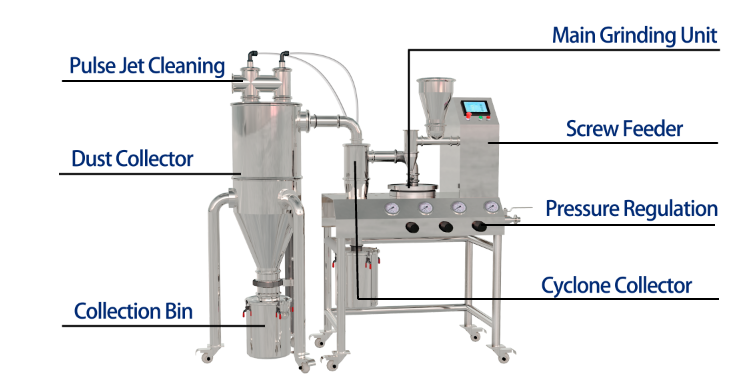
- Whether you need feeder, classifier, cyclone, dust collector or full production line
Related solutions: fluidized bed jet mill, air classifier, powder testing and micronization services.