Ribbon Blender vs Conical Screw Mixer: How to Choose
Ribbon blenders and conical screw mixers can both produce uniform powder blends, but they create movement in different ways. The correct choice depends less on the machine name than on the material's bulk density, flowability, particle strength, component ratio, cleaning requirement and discharge behavior.
This guide compares the two mixer types from a process-engineering perspective. It does not assign one machine as universally better. A representative material trial and a defined sampling method remain the safest basis for final selection.
Need a preliminary recommendation? Send the formulation ratio, bulk density, batch weight, particle-size range and cleaning requirement through the JETER inquiry form.
How a ribbon blender moves powder
A ribbon blender has a horizontal trough with inner and outer helical ribbons. The ribbons move material in opposing axial directions while also creating radial circulation. This forced convective action distributes powders through the working volume and is commonly evaluated for free-flowing or moderately cohesive powders, granules and premixes.
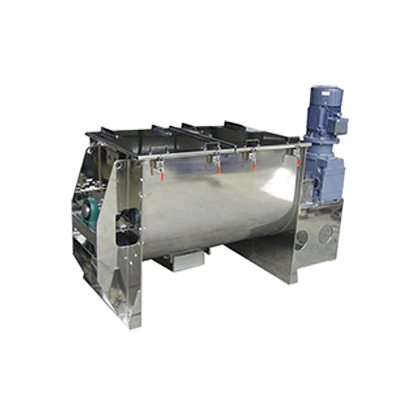
The ribbon blender is often a practical starting point when the process requires a robust horizontal batch mixer, relatively direct loading and discharge, and integration with upstream feeding or downstream packing. Its suitability must still be checked when particles are fragile, the blend contains a very small-dose component, or the product tends to smear and build up on the ribbons.
View the industrial ribbon blender product page for construction, applications and inquiry requirements.
How a conical screw mixer moves powder
A conical screw mixer uses a vertical screw to lift material while the screw assembly travels around the conical vessel. Powder circulates upward near the screw and returns under gravity through other zones of the vessel. This creates a three-dimensional circulation path with controlled mechanical stress.
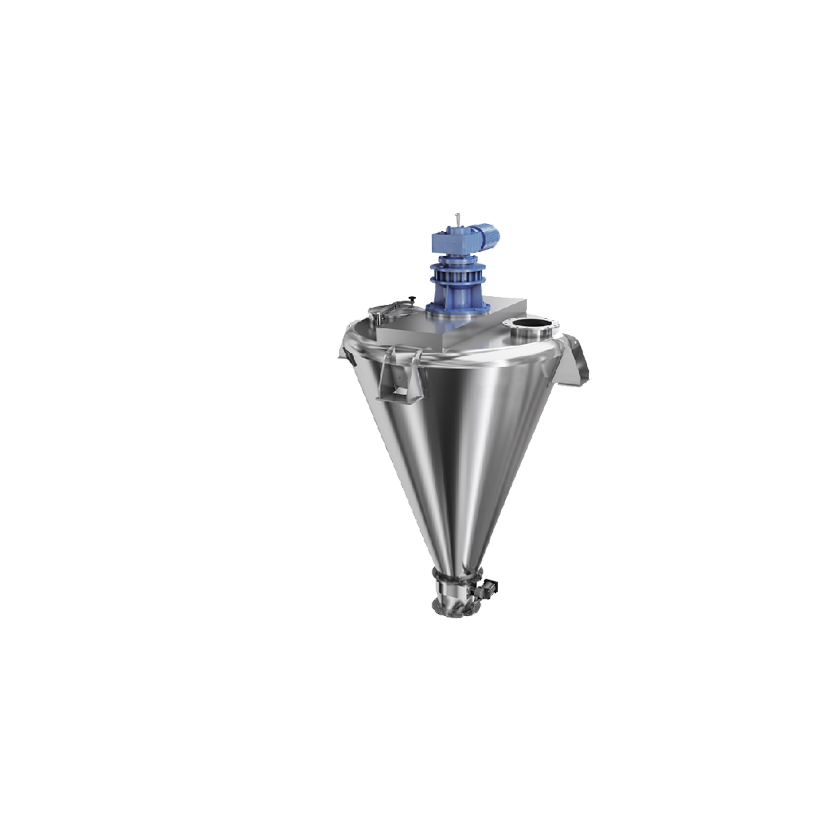
This design is commonly considered when gentle handling, gravity-assisted discharge, cleanability or a large difference in component ratio matters. The cone does not automatically solve segregation or difficult flow. Screw position, speed, fill level, particle properties and the discharge sequence must be evaluated together.
View the conical screw mixer product page for the working principle, selection data and validation questions.
Ribbon blender vs conical screw mixer: engineering comparison
| Decision factor | Ribbon blender | Conical screw mixer |
|---|---|---|
| Vessel orientation | Horizontal trough | Vertical conical vessel |
| Primary movement | Opposing ribbon flows with axial and radial circulation | Screw lifting plus orbital circulation and gravity return |
| Mechanical action | More direct forced convection | Controlled, relatively gentle convective movement |
| Typical selection focus | Robust batch blending, straightforward line integration and general powder mixing | Particle integrity, component distribution, discharge and cleaning-sensitive duties |
| Discharge geometry | Outlet in a horizontal trough; residue depends on outlet and ribbon clearances | Bottom outlet in a cone; gravity assists emptying |
| Scale-up concern | Ribbon geometry, tip speed, drive torque and working volume | Screw circulation, orbital path, fill level and residence pattern |
| Best proof | Representative material trial, multi-point sampling, discharge-residue check and cleaning review | |
Choose a ribbon blender when these conditions dominate
- The formulation is mainly free-flowing or moderately cohesive powder and granules.
- The process needs active convective movement through a horizontal batch chamber.
- Loading, liquid addition, discharge or connection to adjacent equipment favors a horizontal layout.
- The particles can tolerate contact with the ribbon agitator at the selected speed.
- Cleaning access and residual material can be managed with the proposed trough, cover, outlet and ribbon clearances.
Choose a conical screw mixer when these conditions dominate
- The formulation contains fragile particles or requires controlled low-shear circulation.
- A low-dose component must be distributed through a much larger carrier phase.
- Gravity-assisted discharge and reduced internal obstruction are important to the cleaning strategy.
- The product is sensitive to particle breakage, heat generation or overworking.
- The project requires evaluation of jacketed processing, liquid addition or enclosed operation as engineered options.
Material properties that can change the decision
Bulk-density difference
A large density difference can cause segregation during both mixing and discharge. The sampling plan should therefore include the beginning, middle and end of discharge, not only samples taken from the vessel before emptying.
Particle-size distribution
Very different particle sizes can separate by percolation. Mixer type, loading sequence and discharge rate all influence the result. Adding the minor component into a pre-blend may be more effective than relying on longer mixing time.
Cohesiveness and agglomeration
Cohesive powder may circulate poorly or form deposits. The process may require a different agitator arrangement, an intensifier, controlled liquid addition, or a separate deagglomeration step. These decisions should be based on actual material behavior.
Abrasiveness and corrosion
Abrasive or corrosive powders affect contact materials, wall thickness, clearances, surface treatment and expected maintenance. Material compatibility should be reviewed before a mixer quotation is finalized.
Do not size the mixer from vessel volume alone
Vessel capacity and usable batch capacity are not the same. Working volume depends on bulk density, minimum and maximum fill level, required circulation and available headspace. The drive must also be selected for start-up torque and material resistance rather than nominal vessel volume alone.
Provide these inputs during selection:
- Ingredient names and percentages, including the smallest-dose component.
- Loose and tapped bulk density.
- Particle-size range and maximum agglomerate size.
- Batch weight, batches per hour and available floor height.
- Flowability, moisture, abrasiveness, corrosiveness and dust hazard.
- Liquid-addition rate and distribution target, if applicable.
- Required contact material, cleaning method and allowable residue.
- Uniformity acceptance limit and analytical sampling method.
How to compare mixing trials
- Use a representative formulation rather than a convenient substitute with different flow behavior.
- Define the loading sequence and mixing speed before the test.
- Take samples from several locations or discharge intervals.
- Analyze the critical component using an agreed test method.
- Compare uniformity, cycle time, residue, particle damage and cleaning effort.
- Record all settings so the result can be repeated during scale-up.
Frequently asked questions
Which mixer is better for fragile powder?
A conical screw mixer is often the first design evaluated for fragile particles because its circulation can be relatively gentle. The real result depends on screw speed, particle strength, fill level and cycle time, so a material test is still necessary.
Which mixer is better for high-throughput powder blending?
A ribbon blender is often considered for robust batch blending, but throughput cannot be predicted from mixer type alone. Usable batch weight, loading time, mixing endpoint, discharge time and cleaning downtime determine the complete cycle.
Can both mixers add liquid to powder?
Liquid addition can be engineered for either design. Nozzle type, droplet size, spray location, addition rate and wall build-up must be evaluated for the formulation.
Can one test establish the final commercial model?
A laboratory or pilot trial provides important evidence, but scale-up must also consider geometry, power, heat generation, loading sequence and downstream discharge. Record the trial conditions and define the scale-up basis.
Next step: submit material data for selection
JETER supplies powder mixing equipment and integrated powder processing equipment. Send the formulation ratio, material safety information, bulk density, particle size, batch target, cleaning requirement and plant utilities through the inquiry form. The recommendation should be confirmed against the actual material and production target.