Laboratory Jet Mill Manufacturer | Small-Scale Micronization Equipment
Laboratory Scale Grinding
Ultra Fine Powder Processing
Small Batch Production
Low Contamination Design
Precise Particle Size Control
R&D Material Testing
Easy Operation
Laboratory Jet Mill Manufacturer | Small-Scale Micronization Equipment
The Laboratory Jet Mill is a compact ultra-fine grinding system specially designed for research, development and small-scale powder processing applications.
Compared with industrial jet milling systems, laboratory jet mills provide a flexible and efficient solution for material testing, formulation development and process optimization before large-scale production.
The equipment uses high-speed compressed air to accelerate particles and achieve size reduction through particle-to-particle collision. Since there are no grinding media or mechanical grinding components contacting the material, the system provides excellent product purity and minimizes contamination.
JETER Laboratory Jet Mills are widely used in pharmaceutical research, chemical development, battery material testing, ceramic powder research and universities or laboratories requiring precise powder processing.
With compact structure, easy operation and accurate particle size control, the Laboratory Jet Mill is an ideal choice for developing new powder products and optimizing industrial production processes.
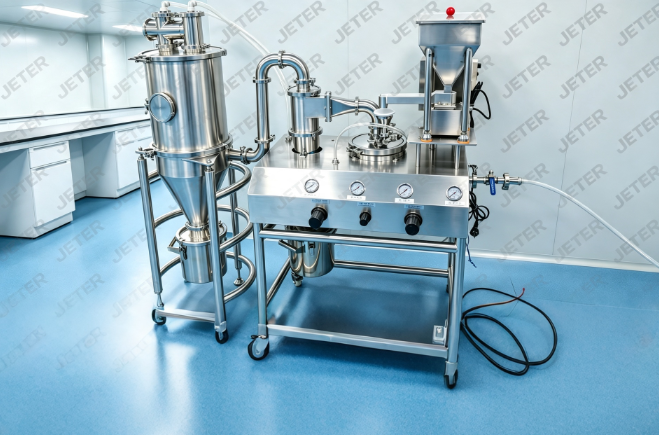
Working Principle of Laboratory Jet Mill
The Laboratory Jet Mill works based on high-speed airflow impact technology.
During operation, compressed air enters the grinding chamber through precision-designed nozzles and generates high-speed airflow jets.
The material particles are accelerated inside the grinding chamber and collide with each other at high velocity. The impact force breaks the particles into smaller sizes without using grinding media.
After grinding, fine particles are separated and collected through the powder collection system.
The final particle size can be adjusted by controlling:
Air pressure
Feeding rate
Material characteristics
Operating parameters
This grinding method provides a clean and efficient solution for laboratory-scale micronization and material research.
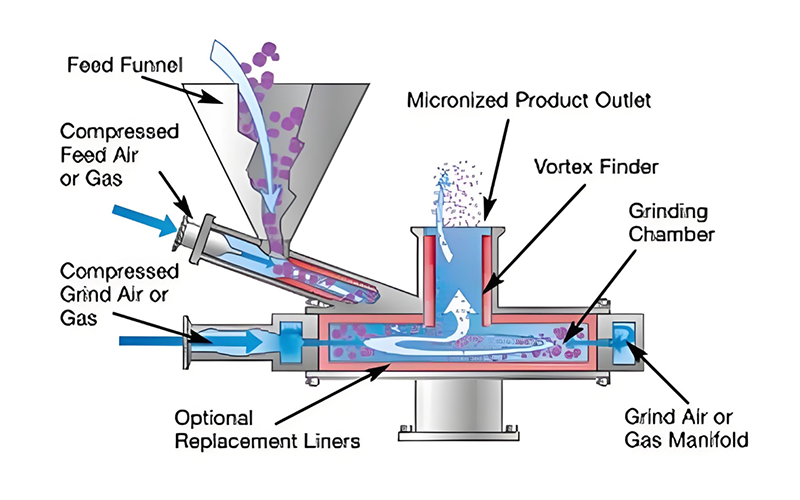
Key Features of Laboratory Jet Mill
Compact Laboratory Design
The compact structure requires limited installation space and is suitable for laboratories, research centers and pilot testing facilities.
Ultra Fine Grinding Capability
The Laboratory Jet Mill can produce micron-sized powders with excellent particle size distribution.
Typical applications include:
Material research
New product development
Process verification
Low Material Loss
Designed for small batch processing, the system minimizes material consumption during testing and development.
This is especially important for expensive materials such as:
Pharmaceutical compounds
Battery materials
Advanced ceramics
High Purity Processing
The grinding process does not require grinding media.
This reduces contamination risks and maintains high product quality.
Easy Operation and Cleaning
The simple structure allows:
Fast cleaning
Easy maintenance
Quick material changeover
Suitable for laboratories handling multiple materials.
Flexible Process Development
The Laboratory Jet Mill allows researchers to evaluate:
Grinding performance
Particle size requirements
Powder characteristics
before moving to industrial-scale production.
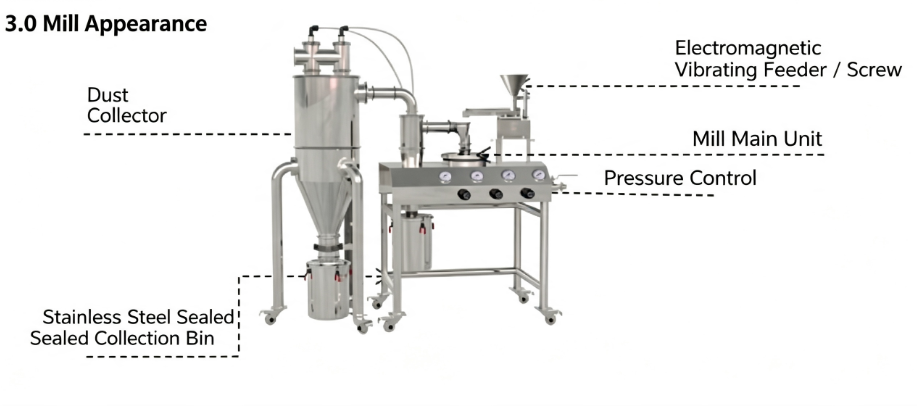
Applications of Laboratory Jet Mill
The Laboratory Jet Mill is widely used for powder research and small-scale production across various industries.
Pharmaceutical Industry
API Micronization Research
In pharmaceutical development, particle size has a significant influence on:
Dissolution performance
Bioavailability
Product stability
Laboratory Jet Mills are used for:
API testing
Drug formulation research
Inhalation powder development
Pharmaceutical intermediate processing
Battery Material Research
The development of advanced battery materials requires precise particle size control.
Laboratory Jet Mills are suitable for:
Lithium iron phosphate (LFP)
Cathode materials
Anode materials
Conductive additives
Benefits:
Small sample requirement
High purity processing
Accurate test results
Ceramic Powder Research
Applications include:
Alumina
Zirconia
Silicon carbide
Advanced ceramic materials
The equipment helps researchers evaluate powder performance before mass production.
Chemical and New Materials
Suitable for:
Functional powders
Pigments
Catalysts
Specialty chemicals
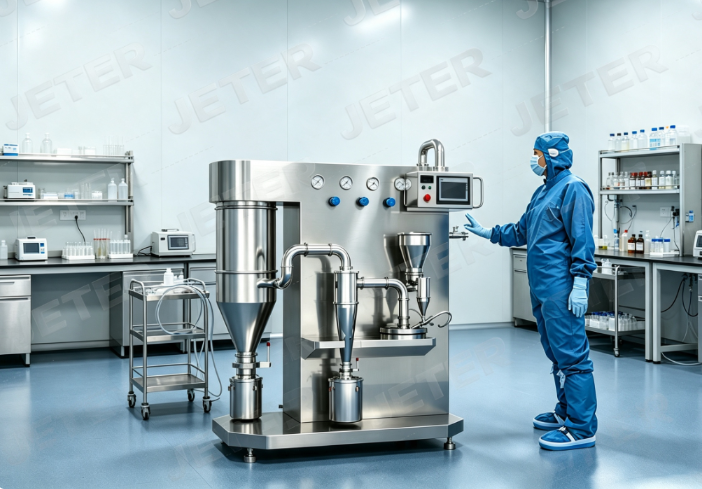
Why Use Laboratory Jet Mill for R&D?
Reduce Development Costs
Small batch testing allows companies to optimize powder processes before investing in large production equipment.
Faster Material Evaluation
Researchers can quickly test different materials and grinding parameters.
Accurate Scale-Up Data
Laboratory testing provides valuable information for designing industrial production systems.
Suitable for High Value Materials
The small processing volume reduces material waste and is ideal for expensive powders.
Complete Laboratory Jet Mill System
A typical laboratory jet milling system includes:
Feeding Unit
Provides controlled feeding for stable operation.
Grinding Chamber
The core unit where particle collision and micronization occur.
Air Supply System
Provides compressed air required for high-speed airflow generation.
Powder Collection System
Collects finished powder efficiently.
Control System
Allows operators to adjust and monitor grinding parameters.
Technical Specifications
JETER Laboratory Jet Mill can be customized according to different research requirements, material characteristics and final particle size targets.
Typical technical specifications include:
| Parameter | Specification |
|---|---|
| Equipment Type | Laboratory Ultra Fine Grinding System |
| Grinding Method | Particle-to-particle collision |
| Grinding Medium | Compressed air / Nitrogen |
| Feeding Mode | Small batch feeding |
| Particle Size Range | Micron and sub-micron level |
| Material Contact Parts | SUS304 / SUS316L optional |
| Application Scale | Laboratory research and pilot testing |
| Control Mode | Manual / Automatic control |
| Applicable Materials | Pharmaceutical, chemical, ceramic, battery and advanced materials |
Actual performance depends on material properties, feeding conditions and process parameters.
Laboratory Jet Mill vs Industrial Jet Mill
Laboratory Jet Mills and industrial jet milling systems are based on the same particle collision technology, but they are designed for different production requirements.
| Comparison | Laboratory Jet Mill | Industrial Jet Mill |
|---|---|---|
| Main Purpose | Research and development | Commercial production |
| Processing Capacity | Small batch | Large-scale continuous production |
| Material Consumption | Low | Higher |
| Installation Space | Compact | Larger production system |
| Application | Testing, formulation development | Manufacturing |
| Flexibility | Very high | Designed for stable production |
| Scale-Up Function | Process verification | Final production solution |
Why Choose Laboratory Jet Mill for R&D?
Laboratory Jet Mill is the ideal choice when companies need to:
Test new materials
Optimize grinding parameters
Develop new powder products
Evaluate particle size requirements
Prepare samples before industrial production
After successful laboratory testing, the process parameters can be transferred to industrial-scale JETER jet milling systems.
Laboratory Jet Mill Application Cases
Case 1: Pharmaceutical API Research
Customer Requirement
A pharmaceutical research company needed a small-scale grinding system for evaluating API micronization performance.
Main requirements:
Small material consumption
High powder purity
Accurate particle size control
JETER Solution
A Laboratory Jet Mill was provided for R&D testing.
The system helped the customer evaluate:
Grinding efficiency
Particle size distribution
Process parameters
The obtained testing data was used for future production-scale equipment selection.
Case 2: Battery Material Development
Customer Requirement
A battery material laboratory required equipment for testing different powder formulations.
Challenges:
Expensive raw materials
Need for high purity
Requirement for repeatable results
JETER Solution
The Laboratory Jet Mill provided:
Low sample consumption
Clean grinding process
Stable testing performance
The customer successfully optimized the powder processing process before mass production.
Case 3: Ceramic Powder Development
Customer Requirement
A ceramic manufacturer needed to evaluate the influence of particle size on final product performance.
JETER Solution
The laboratory grinding system allowed researchers to test different grinding conditions and determine the optimal powder characteristics.
Frequently Asked Questions About Laboratory Jet Mill
What is a Laboratory Jet Mill?
A Laboratory Jet Mill is a small-scale ultra-fine grinding machine designed for research, development and sample preparation.
It uses high-speed compressed air to achieve powder size reduction through particle collision.
What is the difference between a Laboratory Jet Mill and a normal grinder?
Traditional grinders usually rely on mechanical force and grinding components.
A Laboratory Jet Mill uses airflow energy and particle collision, which provides:
Lower contamination
Better purity
Finer particle size control
What materials can be processed by a Laboratory Jet Mill?
It can process various powders including:
Pharmaceutical materials
Chemical powders
Battery materials
Ceramic powders
Mineral materials
Advanced functional materials
What particle size can a Laboratory Jet Mill achieve?
The final particle size depends on material properties and operating conditions.
In many applications, micron-level powder can be achieved.
How much material is required for laboratory testing?
The required material amount depends on equipment model and application requirements.
Laboratory Jet Mills are designed to minimize sample consumption.
Can the Laboratory Jet Mill use nitrogen?
Yes.
For oxidation-sensitive or special materials, nitrogen or other inert gases can be used instead of compressed air.
Can laboratory test results be used for industrial production?
Yes.
Laboratory testing provides important process data for industrial equipment selection and scale-up design.
Can JETER customize Laboratory Jet Mill systems?
Yes.
JETER can customize:
Processing capacity
Material contact materials
Control systems
Collection methods
Special atmosphere requirements
Why Choose JETER as Your Laboratory Jet Mill Manufacturer?
Professional Powder Processing Experience
JETER specializes in powder processing equipment including:
Jet Mills
Air Classifiers
Mixers
Dryers
Granulation Equipment
We provide complete powder processing solutions from laboratory testing to industrial production.
Customized Laboratory Solutions
Different materials require different processing conditions.
Our engineering team provides customized solutions based on:
Material characteristics
Required particle size
Testing objectives
Future production requirements
High Quality Manufacturing
JETER Laboratory Jet Mills feature:
Stainless steel construction
Precision manufacturing
Reliable operation
Easy cleaning design
Support from Testing to Production
JETER helps customers throughout the entire process:
Material evaluation
Laboratory testing
Process optimization
Equipment selection
Production scale-up
Related Powder Processing Equipment
Fluidized Bed Jet MillSpiral Jet Mill
For industrial-scale ultra-fine grinding and advanced powder processing.
Spiral Jet Mill
For efficient and economical ultra-fine powder grinding.
Air Classifier
For precise particle size separation and classification.
Get a Laboratory Jet Mill Solution for Your Research
Looking for a reliable laboratory jet mill for powder research and process development?
JETER provides professional laboratory grinding solutions for pharmaceutical, chemical, battery, ceramic and advanced material applications.
Contact our technical team for:
Laboratory testing support
Equipment selection
Customized solutions
Powder processing consultation
JETER — Professional Powder Processing Equipment Manufacturer.
When to Choose a Laboratory Jet Mill
A laboratory jet mill is useful when a customer needs to verify grindability, particle size distribution, yield, collection behavior and contamination risk before investing in pilot or production-scale equipment.
Common Testing Goals
- API and pharmaceutical micronization feasibility
- Battery material and solid electrolyte powder trials
- Small-batch chemical, ceramic, pigment or food powder testing
- Comparing target D50/D90 results before scale-up
From Lab Test to Production Line
After laboratory testing, JETER can help evaluate whether the process should scale toward a Fluidized Bed Jet Mill, a standalone Air Classifier, or a complete grinding and classification system.
What to Send Before a Trial
- Material name and safety information
- Available sample quantity
- Feed size and target particle size distribution
- Expected production capacity after scale-up
- Special requirements such as nitrogen protection, GMP design or contamination limits
Contact JETER to arrange a laboratory jet milling test
Laboratory Jet Mill for Material Testing
A laboratory jet mill helps buyers verify whether a powder can reach the target micron size before investing in a production line. JETER uses lab test data to support model selection, classifier settings and scale-up recommendations.
Suitable test goals
- API, battery, ceramic and chemical powder micronization
- Small-batch feasibility testing before production purchase
- Comparing particle size distribution under different classifier speeds
- Evaluating heat sensitivity, contamination risk and yield
Send these details for testing
- Sample quantity and material safety information
- Initial particle size, target D50/D90/D97 and capacity goal
- Required report format or process parameters
- Scale-up expectation for pilot or production equipment
Next step: powder processing services or contact JETER for lab testing.