Chemical Powder Processing Equipment & Solutions
Chemical powder processing equipment must be selected around the material rather than a generic capacity label. Hardness, abrasiveness, moisture, heat sensitivity, explosibility, bulk density, feed size and required particle-size distribution determine whether a project needs jet milling, mechanical grinding, air classification, mixing, drying, granulation or a combined production line.
Typical Chemical Powder Applications
- Pigments, dyes, coatings and printing-ink powders
- Catalysts, adsorbents and specialty inorganic chemicals
- Resins, polymers and selected heat-sensitive materials
- Agricultural chemicals and formulation ingredients
- Silica, graphite, ceramic additives and functional powders
- Fine chemicals requiring controlled PSD or low contamination
Equipment Routes for Chemical Powder Processing
| Process goal | Related equipment | Key selection factors |
|---|---|---|
| Fine or ultrafine grinding | Jet mill or fluidized-bed jet mill | Target PSD, purity, temperature and gas demand |
| General-purpose size reduction | Universal mill or air-classifying mill | Hardness, feed size, heat generation and wear |
| Fine-powder separation | Air classifier | Cut point, top-size control and circulating load |
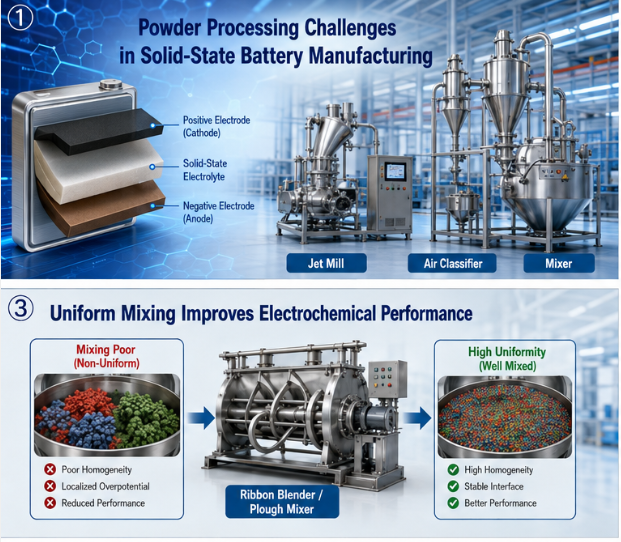
| Powder blending | Industrial powder mixer | Bulk density, uniformity, batch size and cleanability |
| Moisture removal | Powder drying equipment | Initial moisture, thermal sensitivity and residence time |
| Particle enlargement | Granulation equipment | Binder, target granule size and downstream handling |
Particle-Size and Capacity Targets
A useful specification includes the complete particle-size distribution, not only one D50 number. Buyers should define the maximum feed size, target D50/D90/D97, acceptable oversized fraction and required throughput. Actual capacity depends on the material behavior, target fineness and process configuration, so representative testing is recommended before final sizing.
Working Principle and Process Integration
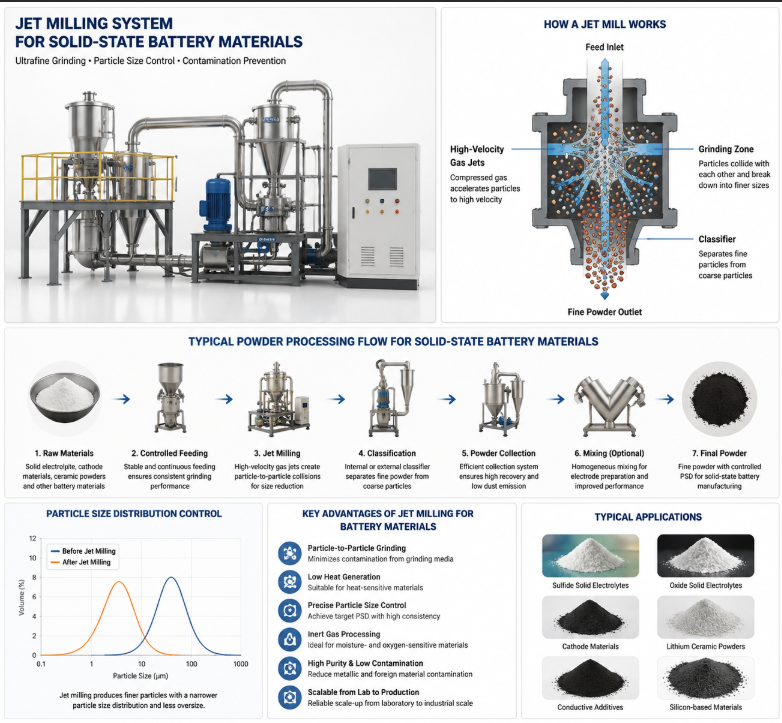
Jet mills use compressed process gas to accelerate particles and create particle-to-particle collisions. Mechanical mills use impact, shear or classification-assisted grinding. Air classifiers separate particles according to aerodynamic behavior. These operations can be integrated with controlled feeding, dust collection, conveying, mixing, drying or granulation to form a complete chemical powder line.
Safety, Wear and Contamination Review
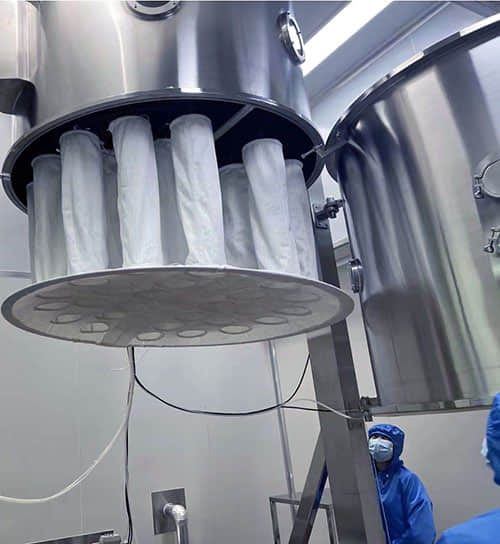
Chemical powder projects may require dust containment, suitable grounding, explosion-risk assessment, inert-gas operation or special product-contact materials. Abrasive materials may require wear-resistant components, while corrosive materials require a compatibility review. Final safety measures must be based on the material safety data and applicable site standards.
Questions for Equipment Selection
- What is the exact material and application?
- What are the feed size and required D50, D90 or D97?
- What hourly capacity or batch size is required?
- Is the powder abrasive, corrosive, cohesive or heat-sensitive?
- Are nitrogen protection or closed-loop processing required?
- What contamination and product-contact limits apply?
- Does the line also require mixing, drying, granulation or conveying?
Arrange material testing and process evaluation before final equipment sizing.
Related Chemical Powder Equipment
- Powder grinding and milling equipment
- Air classifiers
- Powder mixers
- Industrial dryers
- Powder granulators
- Vacuum conveying equipment
Frequently Asked Questions
Which mill is suitable for fine chemical powders?
The answer depends on hardness, feed size, target PSD, temperature sensitivity, purity and capacity. Jet mills suit selected fine and contamination-sensitive powders; mechanical or air-classifying mills can be more economical for other materials.
Can chemical powders be processed under nitrogen?
Inert-gas configurations can be evaluated when oxygen, moisture or combustion risk requires controlled-atmosphere processing. The design must follow the material safety data and project risk assessment.
How is wear contamination controlled?
Product-contact materials, liners, operating speed, feed preparation and process route are selected according to abrasiveness and contamination limits. Material testing helps compare available configurations.
Can JETER provide a complete chemical powder line?
JETER can combine feeding, milling, classification, collection, conveying, mixing, drying, granulation and controls according to the required process.
What should be sent for a quotation?
Provide the material name and SDS, feed size, target PSD, capacity, moisture, bulk density, temperature limit, construction requirements and any inert-gas or dust-control needs.
Request a Chemical Powder Processing Proposal
Share your powder specification and current process problem. JETER will review the material, target particle size, capacity and supporting operations before recommending a testing and equipment route.
Contact JETER for chemical powder equipment selection and a customized proposal.