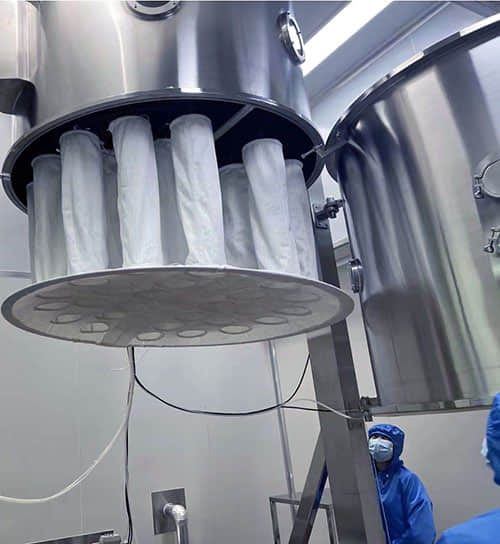
Battery Material Powder Processing & Solid Electrolyte Jet Milling
Introduction
Particle size is not simply a specification on a material datasheet when working with solid-state battery materials.
It can influence how powders flow, how particles pack together, how solid-solid interfaces are formed, and how consistently a material behaves during downstream processing.
This becomes particularly important when moving from laboratory experiments toward pilot-scale or industrial production.
Solid electrolytes, cathode materials, ceramic powders, and other functional battery materials may require controlled particle size distributions without excessive heat generation, mechanical wear, or foreign-material contamination.
For these applications, jet milling provides a different approach to conventional size-reduction equipment.
Instead of relying on grinding media, blades, or mechanical impact surfaces, a jet mill uses high-velocity gas to accelerate particles and create particle-to-particle collisions inside a controlled grinding zone.
The result is a dry grinding process that can be engineered for fine and ultrafine powder production while minimizing contact between the material and mechanical components.
This chapter examines the engineering considerations behind jet milling for solid-state battery materials, including grinding principles, particle size control, equipment configuration, atmosphere management, contamination prevention, and scale-up considerations.
1. Why Particle Size Control Matters in Solid-State Battery Materials
Solid-state battery manufacturing involves several powder-based materials with very different physical and chemical characteristics.
Depending on the battery chemistry and process route, these may include:
Sulfide solid electrolytes
Oxide solid electrolytes
Cathode active materials
Lithium-containing ceramic powders
Conductive additives
Silicon-based materials
Other functional inorganic powders
Although these materials are different, they share one important requirement: their physical properties must remain consistent from batch to batch.
Particle size distribution is one of the most important variables.
A powder containing a large proportion of oversized particles may have poor packing characteristics. On the other hand, excessive ultrafines can increase surface area, promote agglomeration, and create handling difficulties.
The objective is therefore not simply to produce the smallest possible particles.
The engineering objective is to achieve the required particle size distribution with stable processing conditions.
This distinction is particularly important when selecting a jet mill.
2. What Is a Jet Mill?
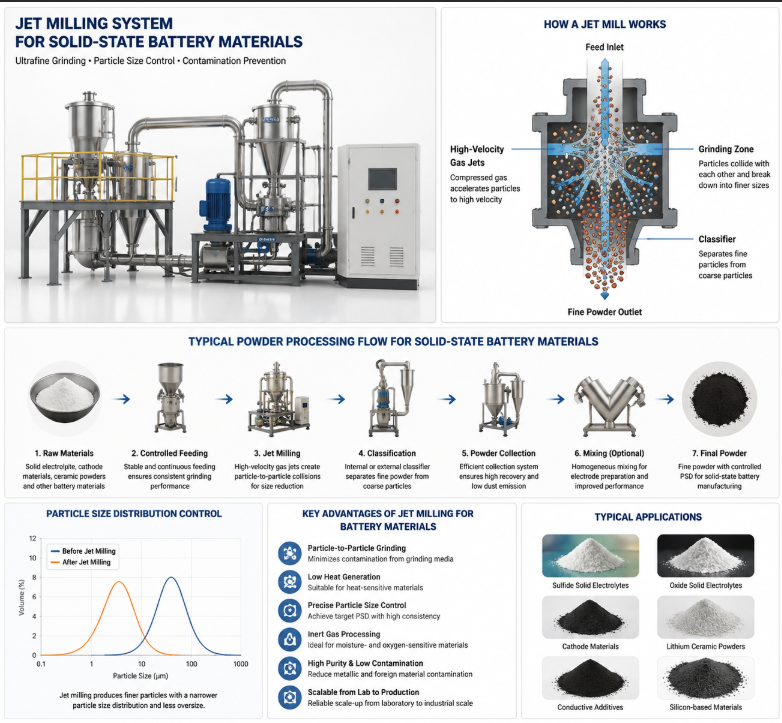
A jet mill is a dry powder grinding machine that uses compressed air, nitrogen, or another suitable gas as the grinding medium.
The basic process is relatively straightforward.
Feed material enters the grinding chamber and is accelerated by high-velocity gas jets.
Inside the grinding zone, particles collide with one another at high velocity.
These repeated particle-to-particle impacts reduce the particle size.
Fine particles are then separated from coarser particles through an internal classifier or downstream classification system.
A simplified process can be represented as:
Feed Powder
↓
Controlled Feeding
↓
High-Velocity Gas Jets
↓
Particle-to-Particle Collision
↓
Size Classification
↓
Fine Powder Collection
The important point is that the grinding mechanism does not depend on conventional grinding media.
This provides several advantages for applications where contamination, temperature rise, or material degradation must be carefully controlled.
3. How Jet Milling Differs from Conventional Mechanical Grinding
Traditional grinding equipment can use hammers, pins, blades, rollers, balls, or other mechanical components to transfer energy to the material.
These technologies remain useful for many industrial powders.
However, advanced battery materials can impose additional requirements.
A jet mill approaches the problem differently.
| Processing Factor | Conventional Mechanical Grinding | Jet Milling |
|---|---|---|
| Grinding mechanism | Mechanical impact or compression | Particle-to-particle collision |
| Grinding media | May be required | Not required |
| Product contamination | Depends on equipment design | Can be minimized |
| Heat generation | Can be significant | Generally lower |
| Fine powder capability | Application dependent | Well suited to fine grinding |
| Atmosphere control | Equipment dependent | Can be engineered as a closed system |
| Wear components | May contact product | Reduced direct product contact |
| Battery material applications | Material dependent | Suitable for selected sensitive powders |
This does not mean that jet milling is automatically the best solution for every battery material.
Material properties, feed size, target PSD, throughput, atmosphere requirements, and downstream processing must all be evaluated before selecting the equipment.
4. Jet Milling for Solid Electrolyte Powders
Solid electrolytes are among the most technically demanding materials in solid-state battery powder processing.
Two broad material families are frequently discussed in solid-state battery development:
Sulfide-based solid electrolytes
Oxide-based solid electrolytes
Their processing characteristics are not identical.
A grinding system designed for an oxide ceramic powder may not be suitable for a moisture-sensitive sulfide material without additional engineering measures.
Therefore, the first step in selecting a jet mill should always be understanding the material itself.
4.1 Sulfide Solid Electrolytes
Sulfide electrolytes can be highly sensitive to moisture and atmospheric conditions.
For this reason, the grinding system may need to operate under a controlled atmosphere.
Typical engineering considerations include:
Closed powder transfer
Nitrogen or inert gas protection
Moisture control
Oxygen monitoring where required
Sealed feeding
Controlled product discharge
Appropriate dust collection
The objective is not simply to grind the powder.
The objective is to maintain the material's required characteristics throughout the complete processing cycle.
This is why a battery material jet milling system should be considered as a process package rather than only as a grinding chamber.
5. Jet Milling of Oxide and Ceramic Electrolytes
Oxide solid electrolytes and other ceramic battery materials may have high hardness and abrasive characteristics.
This creates a different engineering challenge.
The grinding system must provide the required particle size reduction while controlling wear and preventing unwanted material contamination.
Equipment selection may therefore consider:
Wear-resistant internal components
Ceramic or other suitable lining materials
Product-contact material selection
Classifier design
Gas consumption
Feed particle size
Target particle size
For abrasive materials, simply increasing grinding energy is not always the correct solution.
A better approach is to optimize the combination of:
Feed Size + Gas Velocity + Grinding Geometry + Classification + Residence Time
This can provide a more stable route to the desired particle size distribution.
6. Particle Size Distribution Is More Important Than a Single D50 Value
One common mistake during powder processing development is focusing only on D50.
D50 is useful, but it does not fully describe a powder.
Two materials may have a similar D50 while having significantly different:
D10
D90
Span
Fine fraction
Coarse fraction
Agglomeration characteristics
For battery materials, these differences can become important during electrode preparation and powder compaction.
For this reason, jet mill development should consider the complete particle size distribution rather than targeting a single number.
For example:
Feed Powder
D50: 20 μm
↓
Jet Milling
↓
Classification
↓
Product Powder
D50: Process-specific target
D90: Controlled
Oversize fraction: Minimized
The actual target should always be established through material testing and downstream application requirements.
7. The Role of the Classifier in Jet Milling
The grinding chamber produces a broad range of particle sizes.
A classifier determines which particles are sufficiently fine to leave the grinding system.
This is one reason the classifier is a critical component of a modern jet mill.
A typical closed-loop arrangement is:
Feed
↓
Jet Mill
↓
Internal Classifier
↓
Fine Product
↓
Collection System
Particles that remain too coarse can stay within the grinding zone until they reach the required size.
This allows the system to combine grinding and classification in a single process.
For applications requiring tighter particle size control, a separate air classification stage can also be considered.
8. Contamination Prevention During Battery Powder Grinding
Contamination is a major concern when processing high-value battery materials.
Even a relatively small amount of foreign material may become unacceptable depending on the material chemistry and final application.
Potential contamination sources include:
Grinding media
Product-contact metal surfaces
Wear particles
Residual material from previous batches
Dust from surrounding processes
Jet milling can reduce some of these risks because the grinding mechanism relies primarily on particle-to-particle collisions.
However, the complete system still requires careful engineering.
Important considerations include:
Product-contact materials
Materials of construction should be selected according to the chemical and physical characteristics of the powder.
Internal surface design
Dead zones should be minimized where possible.
Cleaning access
The system should allow efficient inspection and cleaning between campaigns.
Powder retention
Material accumulation inside pipelines, valves, filters, and collection equipment should be considered during design.
For multi-product facilities, cleaning validation and cross-contamination control can become especially important.
9. Temperature Control During Jet Milling
Temperature is another factor that should not be overlooked.
Some battery materials are sensitive to thermal exposure.
Mechanical grinding can generate heat through friction and impact.
In a jet milling process, high-pressure gas expands as it enters the grinding system, which can provide a cooling effect.
However, the actual product temperature depends on:
Gas pressure
Gas flow
Feed rate
Material properties
Ambient conditions
Grinding intensity
System configuration
Therefore, the statement that a jet mill is simply a "cold grinding machine" is too general.
The correct engineering approach is to evaluate the thermal behavior of the actual material under representative processing conditions.
For pilot-scale development, temperature measurements should be incorporated into process testing whenever thermal sensitivity is important.
10. Nitrogen and Inert Gas Protection
For moisture- or oxygen-sensitive materials, the gas used for grinding becomes part of the process design.
Compressed air may not always be appropriate.
Depending on the material, nitrogen or another inert gas may be required.
An inert-gas jet milling system may include:
Nitrogen supply
Gas purification
Closed-loop circulation
Pressure control
Oxygen monitoring
Moisture monitoring
Sealed powder transfer
Gas recovery or recycling
The actual configuration depends on the material and production requirements.
For sulfide solid electrolytes in particular, atmospheric exposure should be evaluated carefully during feeding, grinding, classification, collection, and discharge.
11. Feeding System Design
A jet mill cannot compensate for an unstable feeding system.
If the feed rate fluctuates significantly, the grinding conditions can also change.
This may result in variation in:
Product PSD
Throughput
Gas consumption
Classifier performance
Product yield
For battery powder applications, the feeder should therefore be selected according to the powder's:
Bulk density
Flowability
Cohesion
Particle size
Moisture content
Feed rate
Different materials may require different feeding technologies.
A laboratory powder feeder may be sufficient for research-scale trials, while pilot and production systems may require continuous loss-in-weight or other controlled feeding solutions.
12. Powder Collection Is Part of the Grinding Process
Producing a fine powder is only half of the problem.
The system must also collect the powder efficiently.
Fine battery powders can present challenges including:
High dust loading
Poor flowability
Electrostatic behavior
Filter loading
Product loss
A complete jet milling system may therefore include:
Jet Mill
↓
Cyclone or Classifier
↓
Fine Powder Collector
↓
Dust Filtration
↓
Exhaust or Gas Recirculation
The selection of the collection system should be based on particle size, material properties, required recovery rate, and atmosphere requirements.
13. Laboratory, Pilot and Production Jet Mills
One of the most important considerations during battery material development is scale-up.
A laboratory test may produce excellent powder characteristics, but that does not automatically mean the same conditions can be transferred directly to a production machine.
Three stages should be considered.
Laboratory Scale
The primary purpose is material testing.
Typical objectives include:
Feasibility evaluation
Particle size development
Material behavior testing
Initial contamination assessment
Pilot Scale
The pilot stage provides a bridge between laboratory research and industrial production.
Important objectives include:
Throughput verification
Continuous operation
PSD stability
Gas consumption
Powder collection
Cleaning procedures
Process repeatability
Production Scale
At production scale, additional factors become critical:
Energy consumption
Equipment availability
Automation
Maintenance
Safety systems
Material handling
Process integration
A successful scale-up strategy should therefore be based on process data rather than simply increasing equipment dimensions.
14. Key Parameters for Jet Mill Selection
When selecting a jet mill for battery materials, the following information should be established before equipment sizing.
Material
What material will be processed?
Examples:
Solid electrolyte
Cathode powder
Ceramic powder
Silicon material
Conductive additive
Feed Particle Size
What is the maximum feed size?
Target Particle Size
What PSD is required after grinding?
Capacity
What throughput is required?
Atmosphere
Can the material be processed in air, or is inert gas required?
Moisture Requirement
What moisture level must be maintained?
Contamination Requirement
Are there strict limits for metallic or other foreign-element contamination?
Cleaning
Will the system process one material or multiple products?
Product Collection
What recovery efficiency is required?
These parameters should be defined before selecting the final jet mill configuration.
15. Designing a Complete Battery Powder Processing System
A jet mill should not be considered as an isolated machine when designing a solid-state battery powder processing line.
A more complete system may include:
Raw Material Feeding
↓
Drying
↓
Jet Milling
↓
Air Classification
↓
Powder Collection
↓
Mixing
↓
Intermediate Storage
↓
Downstream Electrode Processing
This integrated approach allows engineers to consider the entire powder path rather than optimizing one machine while creating problems elsewhere in the process.
For example, achieving a very fine powder is not necessarily beneficial if the resulting material becomes difficult to transport or mix.
The best process is the one that provides the required powder characteristics while maintaining stable downstream operation.
16. Common Mistakes When Selecting a Battery Material Jet Mill
Several common mistakes appear during early-stage equipment selection.
Mistake 1: Selecting equipment only by capacity
A machine rated for a certain throughput may not achieve the required PSD for every material.
Capacity and particle size capability must be evaluated together.
Mistake 2: Focusing only on D50
A single particle size value cannot describe the entire powder distribution.
D10, D90, fines, coarse fraction, and agglomeration should also be considered.
Mistake 3: Ignoring contamination
For advanced battery materials, product-contact materials and wear should be reviewed during the initial design stage.
Mistake 4: Treating atmosphere control as an accessory
For moisture-sensitive materials, atmosphere management is part of the process itself.
Mistake 5: Scaling directly from laboratory data
Laboratory and production systems may behave differently.
Pilot testing is often necessary to establish reliable operating conditions.
17. When Should You Consider a Jet Mill?
Jet milling is particularly worth evaluating when the application requires a combination of:
Fine particle size
Controlled PSD
Low contamination
Limited thermal exposure
Dry processing
Controlled atmosphere
High-value powder handling
It may be less suitable when the feed material is extremely coarse, highly fibrous, or when the required particle size can be achieved more economically using a different technology.
The correct equipment should always be selected based on the material and process requirements rather than the name of the machine alone.
18. Engineering Approach to Battery Powder Processing
For solid-state battery development, equipment selection should start with the material rather than the machine.
A practical engineering workflow is:
Material Characterization
↓
Grinding Test
↓
Particle Size Analysis
↓
Classification Optimization
↓
Contamination Evaluation
↓
Atmosphere Verification
↓
Pilot-Scale Validation
↓
Production System Design
This approach reduces the risk of selecting equipment before the actual processing behavior is understood.
It also creates a clearer path from laboratory development to pilot production and eventually to commercial manufacturing.
Conclusion
Jet milling can provide an effective route for producing fine and controlled powders used in solid-state battery development.
Its value is not simply the ability to reduce particle size.
For demanding battery materials, the more important advantages are the ability to engineer particle size distribution, reduce direct mechanical contact with the product, control processing temperature, and integrate grinding with classification and controlled-atmosphere powder handling.
However, there is no universal jet mill configuration for every battery material.
Sulfide electrolytes, oxide ceramics, cathode powders, and other advanced materials can require substantially different process conditions and equipment configurations.
The most reliable approach is to begin with material characteristics, define the required powder properties, conduct representative grinding tests, and then develop the equipment configuration around the process requirements.
JETER provides laboratory, pilot-scale, and industrial powder processing solutions for advanced materials, including jet milling, air classification, powder mixing, drying, and integrated powder handling systems.
For projects involving solid electrolytes, lithium battery materials, ceramic powders, or other high-value materials, our engineering team can evaluate the material characteristics and processing targets to develop a suitable powder processing configuration.
Frequently Asked Questions
What is a jet mill used for in battery material processing?
A jet mill is used to reduce particle size and control the particle size distribution of selected battery materials. It is particularly useful when fine grinding, low contamination, and controlled processing conditions are required.
Can jet mills process solid electrolyte powders?
Yes. Jet milling can be considered for selected sulfide, oxide, and other solid electrolyte powders. The appropriate configuration depends on material sensitivity, hardness, moisture requirements, target PSD, and throughput.
Can sulfide solid electrolytes be processed using a jet mill?
Potentially, but the system may require controlled-atmosphere operation because many sulfide electrolytes are sensitive to moisture and atmospheric exposure. Material testing and process validation are recommended before equipment selection.
Does jet milling introduce metal contamination?
Jet milling can reduce contamination risks associated with grinding media because the grinding mechanism relies primarily on particle-to-particle collisions. However, product-contact surfaces, wear components, feeding equipment, pipelines, and collection systems still need to be evaluated.
Is a jet mill suitable for pilot-scale battery production?
Yes. Jet mills can be configured for laboratory, pilot, and industrial applications. Pilot-scale testing is recommended when developing a new battery material process because grinding behavior and powder collection performance may change with scale.
What information is needed to select a jet mill?
The most useful information includes material type, feed particle size, target particle size distribution, required capacity, moisture sensitivity, atmosphere requirements, contamination limits, and downstream processing requirements.
Related Solid-State Battery Powder Processing Articles
- Powder Processing Challenges in Solid-State Battery Manufacturing
- Solid-State Battery Pilot Line Equipment Design
- Battery Pilot Production Line Engineering and Critical Control Points
Need a Jet Milling Solution for Battery Materials?
If you are developing a solid-state battery material, solid electrolyte, ceramic powder, or other advanced material and need to evaluate grinding performance, particle size control, or pilot-scale processing, contact JETER for a customized powder processing solution.
Laboratory Jet Mill | Pilot Jet Mill | Industrial Jet Mill | Air Classifier | Powder Mixing System
[Request a Powder Processing Consultation]
Related Equipment & Solutions
For solid-state battery material powder processing, these JETER pages can help you evaluate the complete process route from material testing to pilot or production-scale equipment selection:
- Fluidized Bed Jet Mill for ultrafine grinding and narrow particle size distribution control.
- Air Classifier for particle size cut control and oversized particle removal.
- Laboratory Jet Mill for small-batch testing before scale-up.
- Powder processing and micronization services for material trials and process verification.
Request a battery material powder processing consultation
Battery Material Jet Milling RFQ Notes
For solid electrolyte and lithium battery material projects, buyers usually care about particle size distribution, metal contamination control, oxygen or moisture sensitivity and pilot-to-production scale-up. JETER can evaluate whether jet milling, air classification or an inert closed-loop system is suitable for your powder.
Send these project details
- Material type, target D50/D90/D97 and feed size
- Moisture, oxygen sensitivity and purity limits
- Required capacity for lab, pilot or production line
- Need for ceramic lining, nitrogen protection or dust collection
Related pages: fluidized bed jet mill, air classifier, send battery powder requirements.