Solid-State Battery Powder Processing Challenges
Chapter 5: Powder Processing Challenges in Solid-State Battery Manufacturing: Engineering Solutions
Introduction
The development of solid-state batteries has introduced new requirements for powder processing technologies. Unlike conventional lithium-ion battery manufacturing, solid-state battery production relies heavily on the precise control of powder characteristics, including particle size distribution, surface properties, moisture content, and material purity.
During pilot-scale production, many challenges do not originate from the chemical composition of battery materials, but from the difficulty of achieving stable and repeatable powder processing performance.
Solid electrolytes, cathode materials, and electrode additives must undergo multiple processing steps, including drying, grinding, classification, mixing, and conditioning. Each step directly influences the final battery performance, especially ionic conductivity, interface contact quality, and electrode density.
Therefore, selecting suitable powder processing equipment is a critical factor for the successful scale-up of solid-state battery manufacturing.
1. Why Powder Processing Plays a Critical Role in Solid-State Battery Manufacturing
Powder characteristics have a significant impact on the performance of solid-state batteries.
In traditional lithium-ion battery production, slurry preparation allows active materials to be processed in a liquid phase. However, solid-state batteries require direct contact between solid particles, making powder properties much more sensitive.
The following factors become essential:
1.1 Particle Size Distribution Control
Particle size distribution (PSD) affects:
Packing density
Contact area between particles
Interface resistance
Material flowability
Electrode uniformity
For solid electrolytes, excessive coarse particles may create insufficient contact points between particles, while excessive fine particles may increase agglomeration and reduce powder flow characteristics.
Therefore, achieving a controlled and stable particle size range is one of the key requirements in solid-state battery powder processing.
1.2 Moisture and Contamination Control
Many solid electrolyte materials, especially sulfide-based electrolytes, are highly sensitive to moisture and atmospheric exposure.
During processing, uncontrolled moisture or contamination can lead to:
Material degradation
Reduced ionic conductivity
Unstable electrochemical performance
For this reason, battery material processing equipment often requires:
Closed processing systems
Inert gas protection
Low contamination design
Easy cleaning structures
Engineering design becomes as important as the processing technology itself.
2. Main Powder Processing Steps in Solid-State Battery Pilot Production
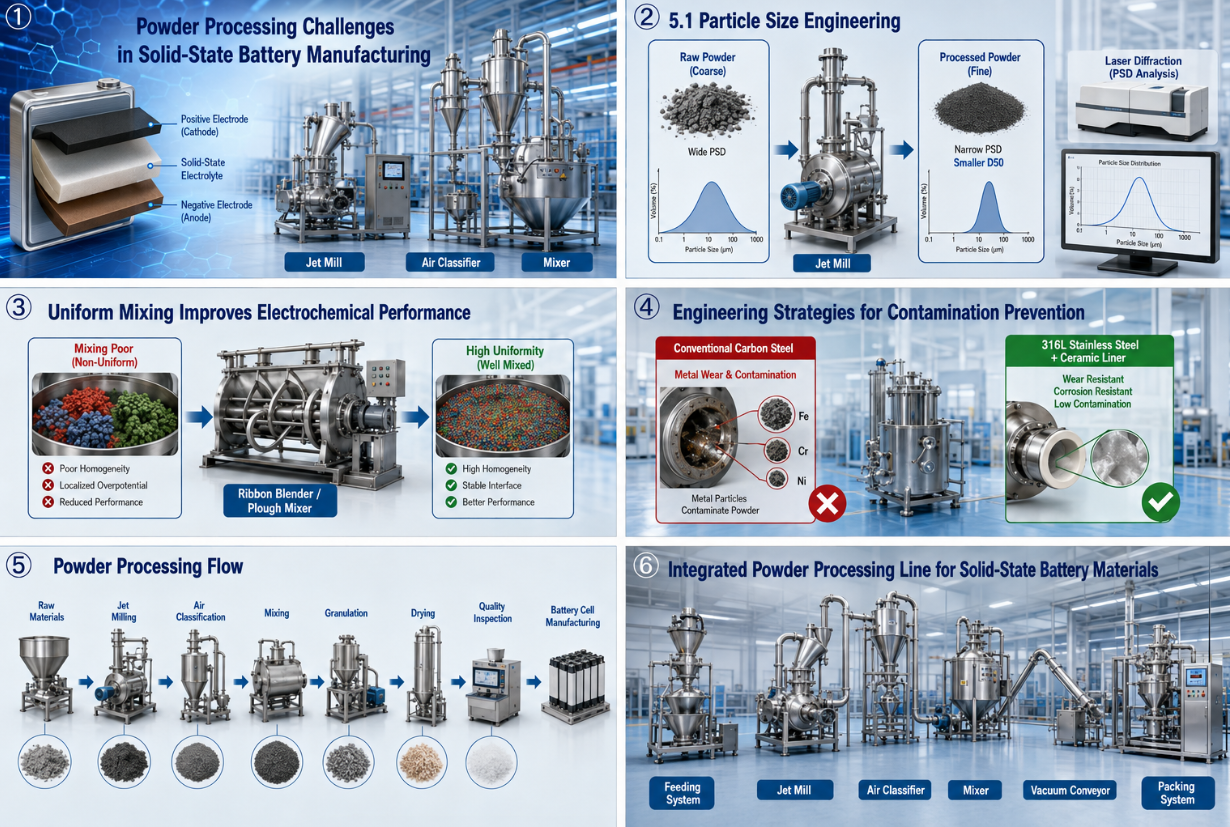
A typical solid-state battery powder processing route may include several key stages:
Raw Material Preparation
↓
Drying and Moisture Removal
↓
Ultrafine Grinding
↓
Particle Classification
↓
Powder Mixing
↓
Granulation or Conditioning
↓
Electrode Material Preparation
Each process requires different equipment technologies to achieve stable production performance.
3. Ultrafine Grinding of Solid-State Battery Materials
The Importance of Advanced Grinding Technology
Solid-state battery materials often require micron-level or even sub-micron particle control.
Traditional mechanical grinding equipment may introduce several limitations:
High mechanical stress
Metal contamination
Excessive heat generation
Wide particle size distribution
For sensitive battery materials, these factors may negatively influence material performance.
Jet Milling Technology for Battery Materials
Jet milling is widely considered an effective solution for processing advanced battery powders.
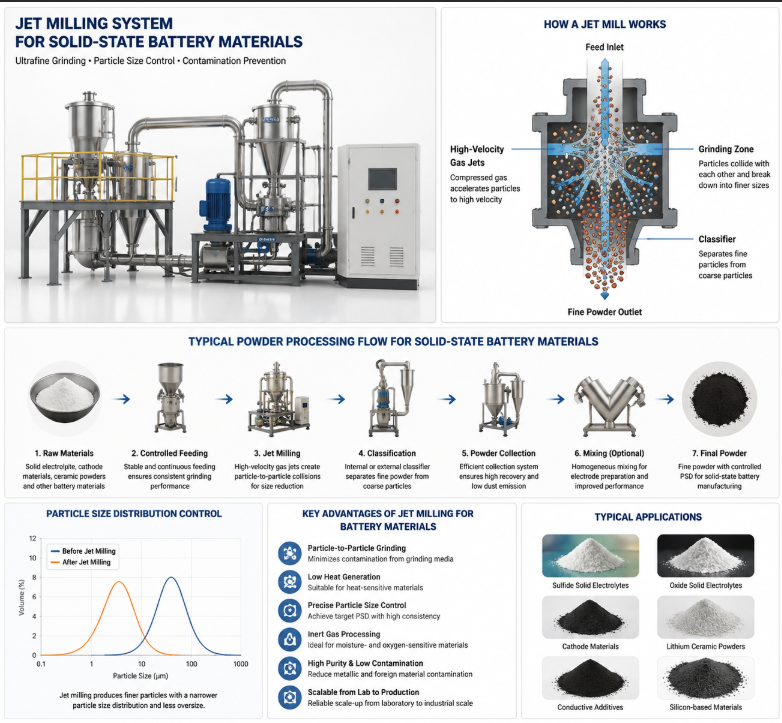
A jet mill uses high-speed compressed gas to create particle-to-particle collisions, reducing material size without mechanical grinding components inside the grinding chamber.
The advantages include:
Low Contamination Processing
Because there are no grinding media or moving grinding parts contacting the material, contamination risk is significantly reduced.
Temperature Control
The expansion of compressed gas provides a cooling effect, making jet mills suitable for heat-sensitive materials.
Fine Particle Production
Jet mills can achieve precise particle size control for applications requiring fine and uniform powders.
For solid-state battery applications, jet milling systems can be designed according to different material characteristics:
Sulfide solid electrolytes
Oxide ceramic electrolytes
Cathode active materials
Conductive additives
Special engineering considerations may include:
Nitrogen protection
Oxygen and moisture control
Closed-loop operation
Explosion protection design
4. Particle Classification: Achieving Consistent Powder Quality
Grinding alone cannot guarantee the required powder quality.
After size reduction, powder classification becomes an essential step to separate particles according to their size distribution.
Why Classification Is Important
An uncontrolled particle size distribution may cause:
Poor powder packing
Uneven electrode structure
Increased interface resistance
Reduced production consistency
Air classification technology provides accurate particle separation without introducing additional mechanical stress.
Air Classifier Technology for Battery Powder Processing
An air classifier uses aerodynamic forces to separate fine and coarse particles.
The main advantages include:
Precise cut point control
Continuous operation
Low contamination risk
Integration with grinding systems
For battery material applications, air classifiers can be combined with jet mills to create a complete closed-loop powder processing system.
Example:
Jet Mill
↓
Air Classifier
↓
Qualified Product Collection
↓
Oversized Particle Recycling
This configuration improves production efficiency while maintaining stable powder quality.
5. Mixing Technology for Solid-State Battery Materials
After particle size control, powder mixing becomes another critical process.
Solid-state battery electrodes typically contain multiple components:
Active materials
Solid electrolytes
Conductive additives
Binders
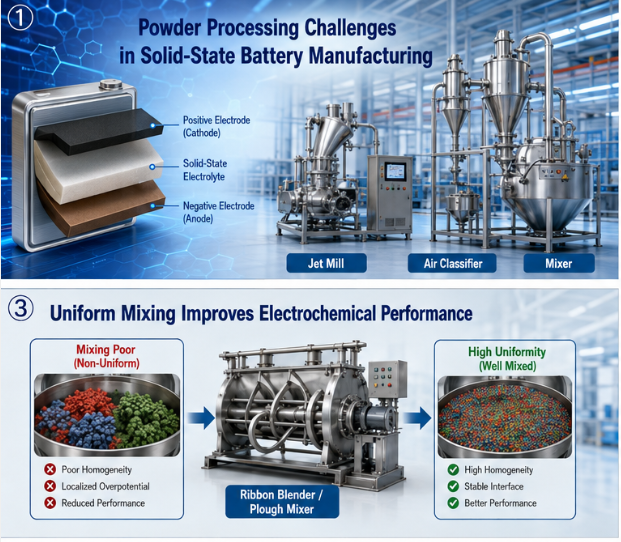
Achieving uniform distribution is essential for consistent electrochemical performance.
Challenges During Powder Mixing
Battery powders often have:
Different particle sizes
Different densities
Different surface characteristics
Poor mixing may result in:
Material segregation
Uneven conductivity
Inconsistent electrode performance
Therefore, mixing equipment must provide:
Gentle processing
High uniformity
Low shear stress
Minimal material damage
6. Engineering Considerations When Selecting Powder Processing Equipment
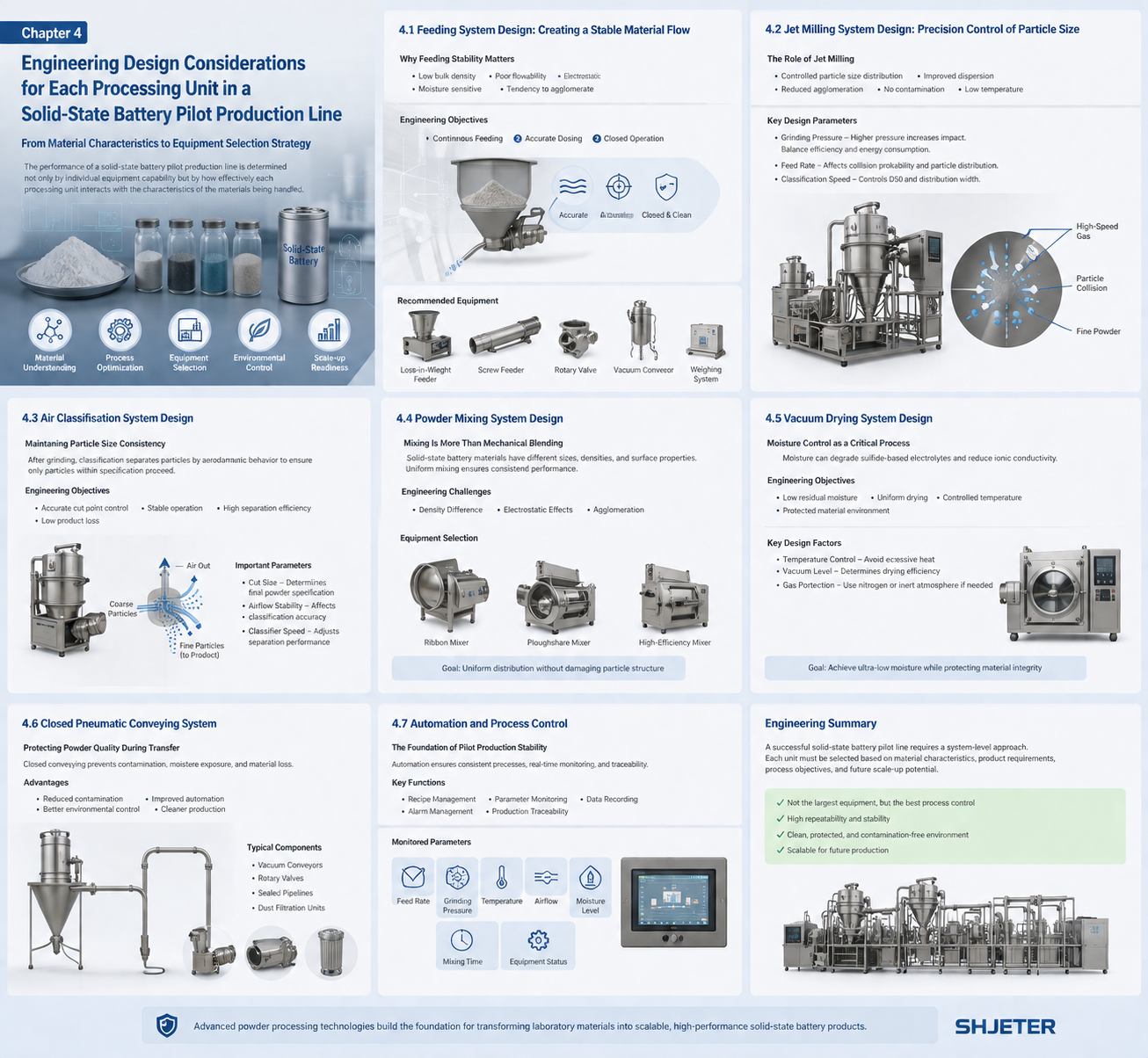
When designing a solid-state battery pilot production line, equipment selection should consider more than production capacity.
The following factors should be evaluated:
Material Characteristics
Different materials require different processing solutions.
Important parameters include:
Hardness
Moisture sensitivity
Thermal stability
Chemical activity
Target Particle Size
The required particle size range determines:
Grinding technology
Classification method
Equipment configuration
Production Capacity
Pilot lines require flexible equipment that can support:
Laboratory research
Small batch production
Scale-up verification
Atmosphere Requirements
For sensitive battery materials, processing environments may require:
Nitrogen atmosphere
Dry air conditions
Oxygen control
Cleaning and Maintenance
Battery material equipment should be designed for:
Easy disassembly
Reduced material retention
Simple cleaning procedures
This is particularly important when processing different battery material systems.
7. Integrated Powder Processing Solutions for Solid-State Battery Development
The successful commercialization of solid-state batteries requires not only advanced materials but also reliable powder processing technologies.
A complete powder processing solution may include:
Jet Milling Systems
Air Classification Systems
Powder Mixing Equipment
Drying Systems
Automated Powder Handling Systems
By combining these technologies, battery manufacturers can achieve better control over powder properties and improve the repeatability of pilot-scale production.
Conclusion
Powder processing is one of the key engineering challenges in solid-state battery manufacturing.
From particle size reduction and classification to mixing and material handling, every processing step influences the final battery performance.
For companies developing solid-state battery technologies, selecting the right powder processing equipment at the pilot stage can significantly improve process stability and accelerate industrialization.
JETER provides customized powder processing solutions for advanced materials, including jet milling, air classification, mixing, drying, and integrated powder handling systems.
Our engineering team works with customers to develop reliable processing solutions based on material characteristics, production requirements, and application goals.
Related Equipment & Solutions
For solid-state battery material powder processing, these JETER pages can help you evaluate the complete process route from material testing to pilot or production-scale equipment selection:
- Fluidized Bed Jet Mill for ultrafine grinding and narrow particle size distribution control.
- Air Classifier for particle size cut control and oversized particle removal.
- Laboratory Jet Mill for small-batch testing before scale-up.
- Powder processing and micronization services for material trials and process verification.
Request a battery material powder processing consultation
Solid-State Battery Powder Processing Checklist
Battery material buyers often face agglomeration, contamination, heat sensitivity and inconsistent particle size. A complete process review should compare jet milling, classification, feeding, dust collection and closed-loop protection instead of selecting a grinder alone.
- Define target PSD and acceptable oversize percentage
- Check metal contamination and liner material requirements
- Confirm whether nitrogen protection or dehumidification is needed
- Use lab testing data before production-line investment
Request powder testing or review laboratory jet mill options.