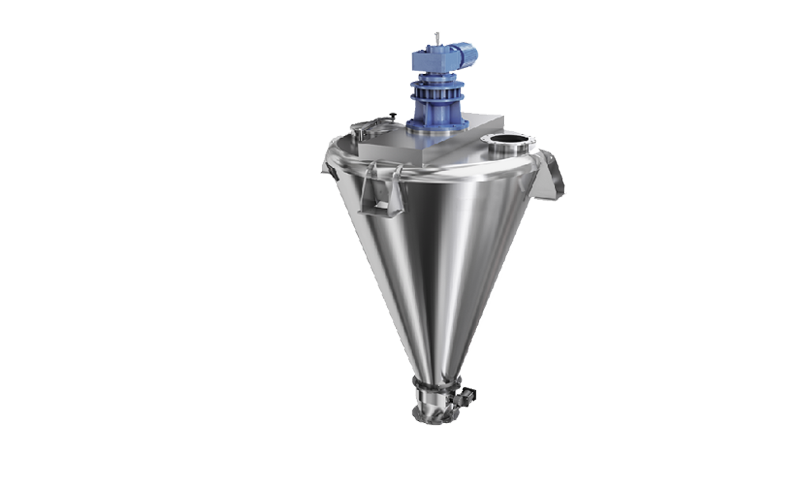
Conical Screw Mixer for Gentle Powder Blending
The conical screw mixer combines vertical screw lifting with orbital circulation inside a conical vessel. It is intended for controlled powder blending where particle integrity, discharge, cleanability and batch uniformity must be evaluated against the actual formulation. Final configuration depends on bulk density, particle size, batch weight, flow behavior and cleaning requirements.
A conical screw mixer is designed for powders that need thorough blending with controlled mechanical stress. Inside the conical vessel, the vertical screw lifts material while the screw assembly travels around the vessel wall. This combined axial and orbital movement continuously transfers powder between the center and the perimeter, reducing stagnant zones without depending on high-speed impact.
Request a mixer recommendation: send the material name, bulk density, batch weight, particle-size range and required cleaning standard through our contact form. JETER will review the process before recommending a configuration.
How the conical screw mixing principle works
The screw conveys powder upward from the lower section of the vessel. At the same time, the orbital arm moves the screw along the conical wall, causing material to descend and circulate through the full vessel volume. The cone geometry supports complete discharge and gives the mixing mechanism access to different zones of the batch.
This motion is useful when a formulation contains fragile particles, low-dose additives or components with different bulk densities. The correct result still depends on the actual material: free-flowing powders, cohesive powders and blends containing liquids require different screw geometry, speed and cycle design.
Suitable materials and industries
- Pharmaceutical powders and excipients where uniform distribution and cleanability are important.
- Food ingredients, nutrition powders and premixes that need controlled handling.
- Chemical powders, pigments and additives with different bulk densities.
- Battery and advanced-material powders where particle integrity and cross-contamination control matter.
- Feed, ceramic and mineral formulations that require batch blending before another process step.
Material compatibility must be confirmed before selection. Abrasiveness, moisture, temperature, electrostatic behavior, dust explosibility and corrosion can change the required contact material, seal, drive and safety design.
Conical screw mixer vs ribbon blender
A ribbon blender uses horizontal inner and outer ribbons to create radial and axial movement. It is often considered for robust, free-flowing powders and higher-throughput batch production. A conical screw mixer uses a vertical lifting and orbital circulation pattern and is often preferred when gentle handling, complete discharge or a large difference in component ratio is more important.
| Selection factor | Conical screw mixer | Ribbon blender |
|---|---|---|
| Mixing action | Vertical lifting plus orbital circulation | Horizontal radial and axial movement |
| Particle handling | Controlled, relatively gentle circulation | More intensive bulk movement |
| Discharge | Conical bottom supports gravity discharge | Central or end discharge from horizontal trough |
| Best decision method | Compare representative material trials, sampling results, discharge residue, cleaning time and required batch cycle. | |
Information required for mixer sizing
Do not select a mixer from vessel volume alone. Provide the following process data so the working volume, drive, seals and internals can be evaluated:
- Material names, formulation percentages and whether any component is hazardous.
- Loose and tapped bulk density, particle-size distribution and maximum agglomerate size.
- Batch mass, target working volume and expected batches per hour or shift.
- Flowability, cohesiveness, abrasiveness, hygroscopicity and electrostatic behavior.
- Maximum allowable temperature and sensitivity to shear or particle breakage.
- Liquid-addition requirement, if any, including addition rate and desired distribution.
- Cleaning method, allowable residue, contact-material requirement and surface-finish expectation.
- Required sampling plan and acceptance criterion for blend uniformity.
How to verify mixing uniformity
A useful trial starts with a representative formulation and a defined sampling plan. Samples should be collected from multiple locations or discharge intervals rather than from a single convenient point. The analytical method and acceptance limit should be agreed before testing. Results can then be compared across mixing time, loading level and discharge sequence. This is more reliable than assuming a fixed mixing time for every powder.
Cleaning, containment and integration
The vessel access, seal arrangement, discharge valve and surface finish should match the cleaning and containment requirement. For regulated or contamination-sensitive products, review product-contact materials, dead zones, inspection access and the cleaning sequence. The mixer can be evaluated as part of a wider powder processing equipment line that may include feeding, milling, classification, granulation or drying.
Need a process review? Share a material data sheet and target batch information. We can discuss whether a conical screw mixer, ribbon blender or another powder mixer is the better starting point.
Frequently asked questions
Can a conical screw mixer handle powders with different bulk densities?
It can be suitable, but the density ratio, component percentage and segregation tendency must be evaluated. A representative test and multi-point sampling plan are recommended for critical formulations.
What determines the usable batch size?
Usable batch size depends on bulk density, required working volume, screw engagement, circulation pattern and process objective. Both minimum and maximum practical loading should be confirmed for the selected model.
Can liquid be added during powder mixing?
Liquid addition can be considered as a project option when the formulation permits it. The nozzle position, droplet size, addition rate and risk of wall build-up need to be reviewed through testing.
How is the correct mixing time determined?
Mixing time should be established by sampling and analysis of the real formulation. Excessive mixing can waste energy or contribute to segregation in some blends, so a validated endpoint is preferable to an arbitrary cycle.
What should be sent with an inquiry?
Send the material, formulation ratio, bulk density, particle size, batch weight, required output, cleaning standard and available plant utilities. Photos or a material safety data sheet are helpful when available.
Start your selection: contact JETER with your process data to receive a configuration discussion based on the actual powder and production target.
Comparing mixer types? Read our ribbon blender vs conical screw mixer selection guide to evaluate powder behavior, shear, discharge, cleaning and validation requirements before selecting equipment.