Tips For Using High Efficiency Jet Mill A Guide To Improve Crushing Efficiency And Output
In today’s competitive industrial landscape, optimizing your jet mill operation is not just an option—it’s a necessity. As a leading manufacturer of high-performance jet milling systems, we’ve compiled practical, data-driven strategies to help you improve grinding efficiency, increase output, and reduce downtime. Whether you’re processing pharmaceuticals, chemicals, new materials, or advanced powders, these tips will boost your productivity and maximize return on investment.
1. Optimize Air Pressure and Nozzle Design for Precision Milling
✔ Optimal Air Pressure
Recommended pressure range: Determine the critical breakage pressure of your material through testing. Operate slightly above that point (typically 1.5–3x sonic pressure) to ensure sufficient particle acceleration without excessive energy consumption.
Examples: For brittle materials like quartz, 0.6–0.8 MPa is ideal; for ductile materials like plastics, increase to 0.8–1.2 MPa.
✔ Stable Air Supply
Use a two-stage air compressor with an air tank at least 3x pipeline flow volume to reduce pressure fluctuations.
Design pipelines with minimal 90° turns; apply Venturi structures to accelerate airflow and reduce turbulence.
💡 Pro tip: Pair your jet mill with a dynamic classifier to separate fine particles in real-time and reduce over-grinding and energy waste.
✔ Advanced Nozzle Design
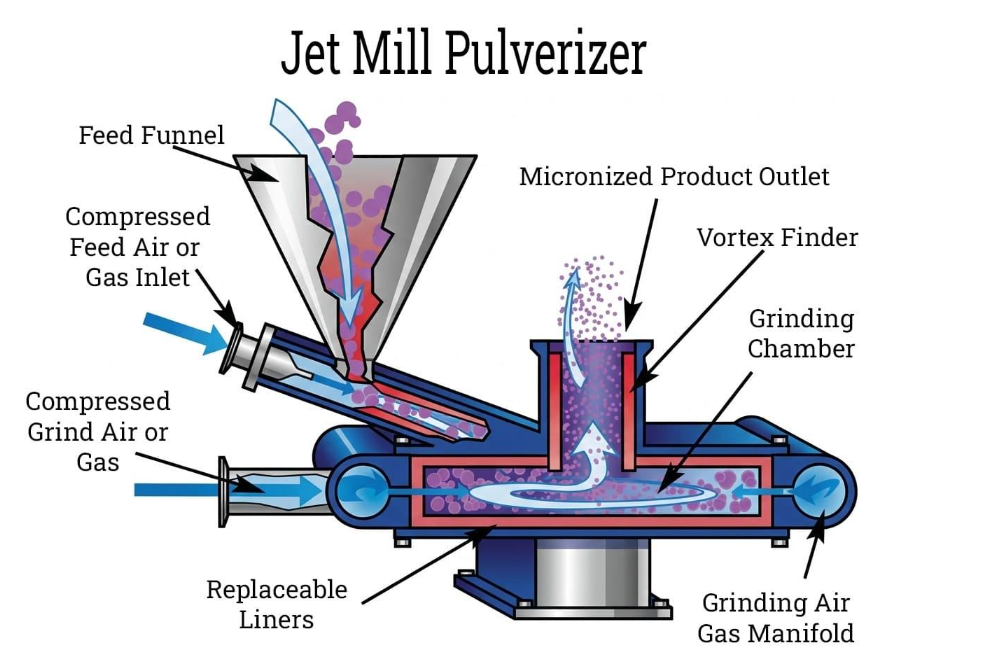
Nozzle shape, angle, and number directly impact turbulence and shear force.
Use Laval nozzles or increase nozzle quantity for finer grinding.
Regularly check for nozzle wear—damaged nozzles can destabilize airflow and reduce performance.
2. Pre-Treat Materials to Minimize Blockage and Wear
✔ Drying
Reduce material moisture to below 1% (adjust based on material), using hot air dryers, vacuum dryers, or fluid bed dryers.
Ensure uniform moisture distribution to prevent clogging.
✔ Pre-Crushing
Use jaw crushers, impact mills, or universal grinders to pre-crush materials to 80–200 mesh, reducing jet mill load.
✔ Flowability Enhancement
Add 0.1%–0.5% nano silica or stearates to improve powder dispersibility.
For high-surface-energy materials, apply plasma treatment or surface coating to reduce stickiness.
3. Match Grinding Medium to the Material
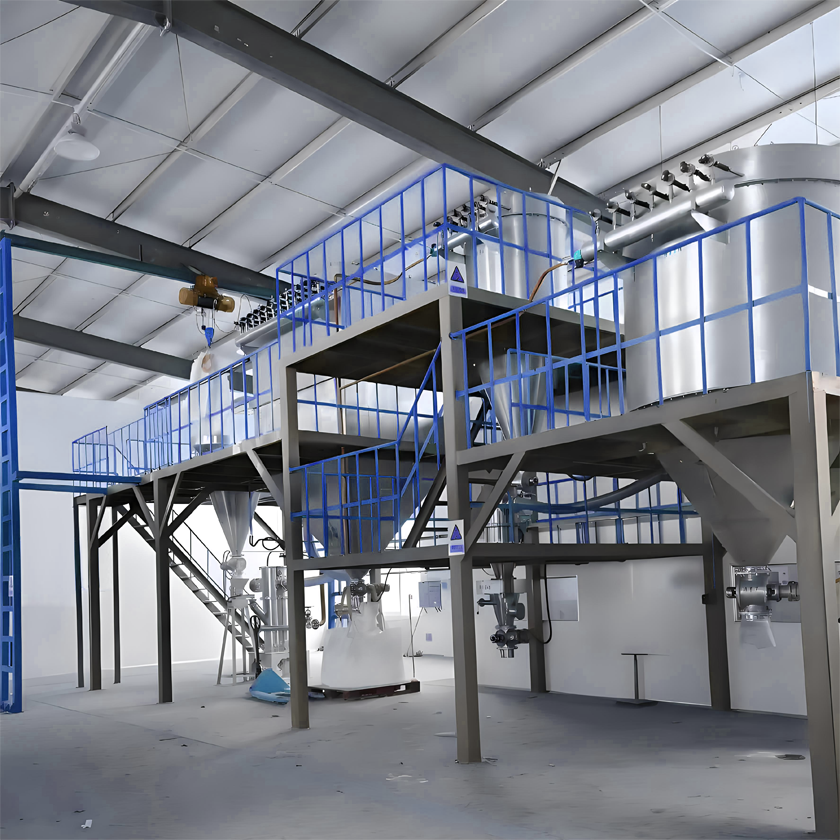
Not all jet mills suit every application. For heat-sensitive APIs, use cryogenic jet mills with liquid nitrogen. For hard materials like carbides, choose ceramic-lined fluidized bed jet mills. Proper equipment selection prevents material degradation and lowers energy cost.
4. Use Advanced Control Systems for Real-Time Optimization
Airflow speed (pressure): Higher pressure = finer particles. Low pressure may result in insufficient grinding.
Classifier speed: Higher speed = smaller cut size. Balance speed with airflow to avoid overheating or energy spikes.
Feeding rate: Too fast = accumulation and inefficient collisions; too slow = reduced throughput. Adjust for optimal residence time and particle size.
5. Troubleshooting Common Issues
Wide particle size distribution: Check classifier stability or add dispersants to prevent agglomeration.
Decreased output: Check for blocked nozzles or insufficient pressure—clean or replace components as needed.
Coarse particles: Increase airflow pressure and classifier speed, reduce feed rate for finer milling.
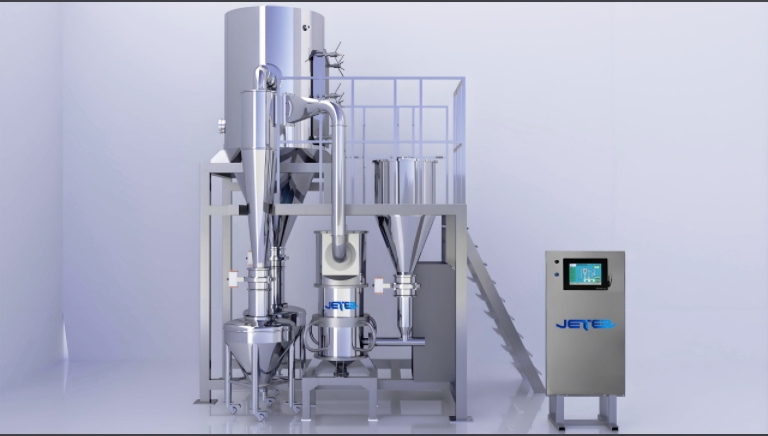
Why Choose Shanghai Jeter Powder Equipment Co., Ltd.?
At Shanghai Jeter, we design energy-efficient jet mills that deliver:
30–50% lower energy consumption with optimized design
Tight particle size distribution (±0.5 µm precision)
24/7 remote monitoring with predictive maintenance alerts
📩 Contact us today for a free consultation and get your customized jet mill optimization plan!