Solid-State Battery Pilot Production Line Process Flow, Equipment Selection, and Engineering Design
Introduction
The transition from conventional lithium-ion batteries to solid-state batteries is reshaping the future of advanced energy storage. As electric vehicles, aviation, renewable energy storage systems, and high-performance electronics continue to demand higher energy density and improved operational safety, solid-state battery technology has become one of the most actively researched fields worldwide.
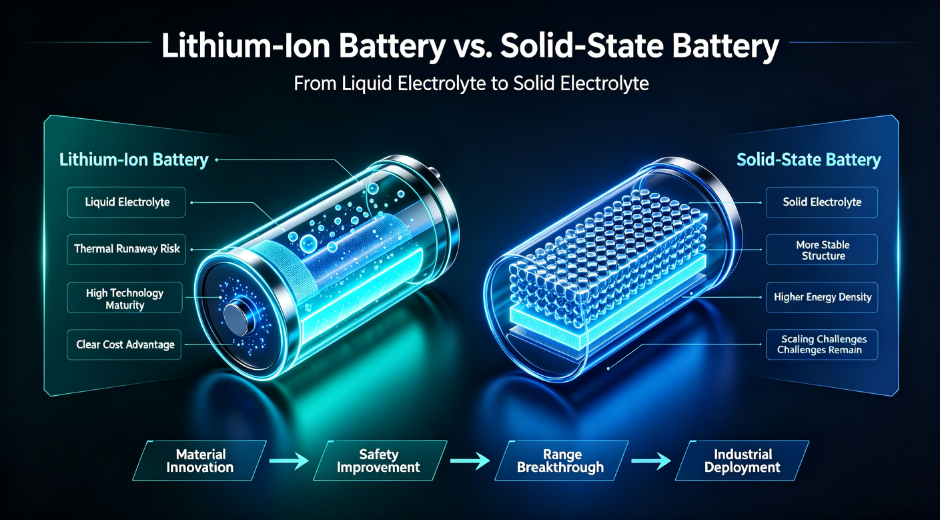
Unlike conventional lithium-ion batteries that rely on liquid electrolytes, solid-state batteries replace the flammable liquid electrolyte with solid ionic conductors. This fundamental change significantly improves thermal stability, reduces safety risks associated with electrolyte leakage, and enables the use of high-capacity electrode materials that were previously impractical in commercial production.
Although laboratory-scale research has achieved remarkable progress during the past decade, industrial commercialization remains a considerable engineering challenge. Many research institutions and battery manufacturers are currently investing in pilot production facilities to bridge the gap between laboratory development and mass manufacturing.
A pilot production line is not simply a scaled-up laboratory. It is an integrated engineering system designed to verify process stability, optimize production parameters, evaluate equipment compatibility, establish quality control standards, and generate reliable manufacturing data before full-scale commercial investment.
Among every manufacturing stage, powder processing is often the least visible yet one of the most critical factors affecting battery performance.
The electrochemical performance of a solid-state battery depends not only on material chemistry but also on the physical characteristics of every powder involved throughout the manufacturing process. Particle size distribution, particle morphology, moisture content, bulk density, flowability, dispersion quality, contamination control, and mixing homogeneity directly influence ionic conductivity, interface resistance, electrode density, cycle life, and ultimately the overall reliability of the battery.
For this reason, advanced powder engineering has become a core technology rather than a supporting process.
A modern pilot production line requires every powder handling stage to operate as a coordinated system instead of individual machines working independently. Material feeding, micronization, classification, mixing, drying, pneumatic conveying, dust collection, storage, and packaging must all function together under precisely controlled conditions to ensure consistent product quality while maintaining production efficiency and environmental safety.
This article presents a practical engineering perspective on designing a solid-state battery pilot production line. Instead of focusing solely on individual equipment, it examines the complete powder processing workflow, explains the engineering considerations behind each production stage, discusses equipment selection strategies, highlights common technical challenges encountered during pilot production, and explores how integrated powder processing systems can support the successful scale-up from laboratory research to commercial manufacturing.
Whether you are planning a new pilot facility, upgrading an existing powder processing system, or evaluating equipment for next-generation battery materials, understanding the interaction between process design and powder engineering is essential for achieving stable, repeatable, and scalable production.