Analysis of ternary material pulverization process: air jet mill
Introduction: The technological revolution of ternary material pulverization process
With the explosive growth of new energy vehicle market, ternary lithium battery (NMC/NCA) as the mainstream choice of power battery, its core material - nickel-cobalt-manganese (or aluminum) hydroxide processing precision directly determines the energy density and cycle life of the battery. In the 16 key processes of material preparation, the selection of equipment for pulverization has a direct impact on the material's specific surface area, vibration density and other core indicators. This article will deeply analyze the current mainstream crushing equipment, and focus on how the technological breakthroughs of the air jet mill to promote the upgrading of the industry.
I. The four mainstream types of ternary material pulverizing equipment and performance comparison
1. Mechanical pulverizer (ball mill/vibrating mill)
○ Working principle: grinding media (steel balls, ceramic balls) through the collision and shear to achieve crushing
○ Advantage: Low equipment cost (about $50,000-$120,000 per unit), suitable for laboratory and small batch production.
○ Limitations: high risk of metal contamination (Fe content easily exceeds the standard), wide particle size distribution (D50±15%), energy consumption >8kW-h/kg
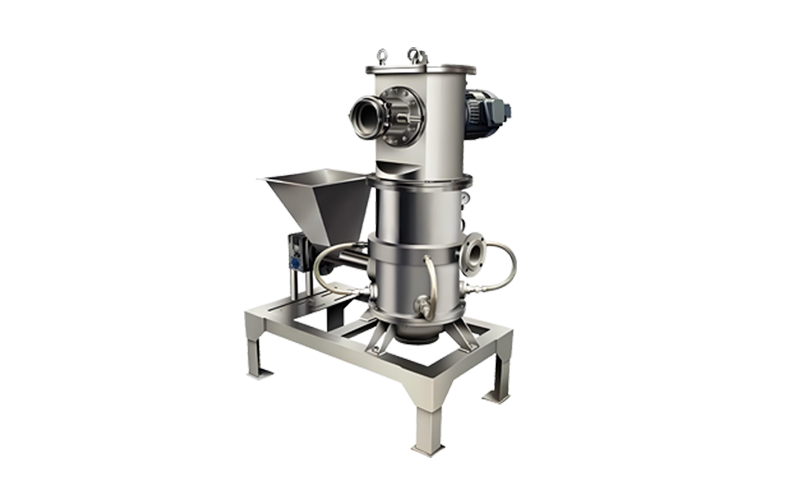
2. Air jet mill (core recommendation)
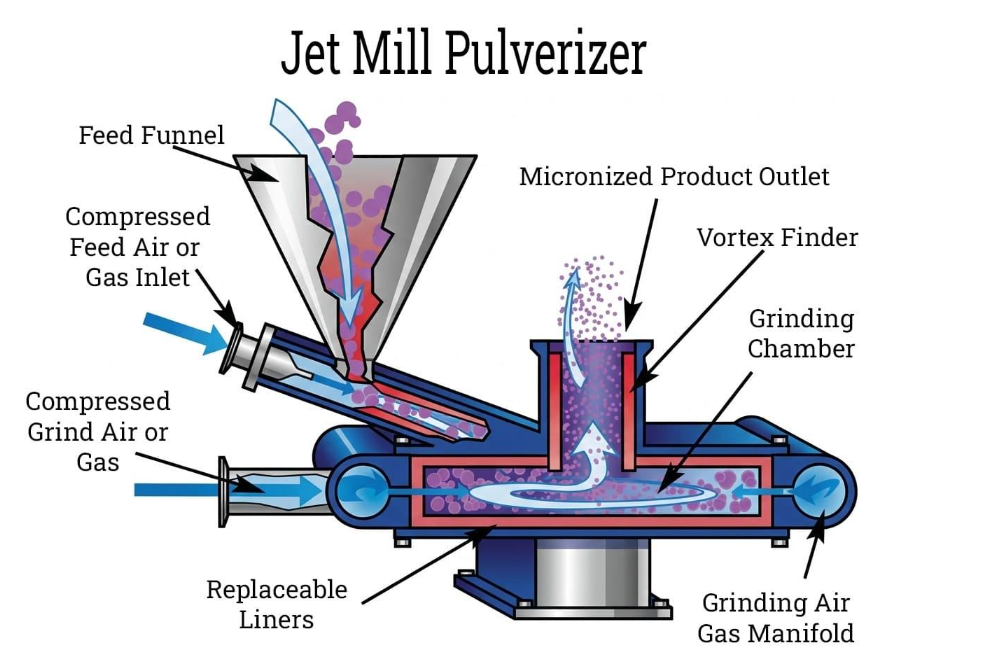
○ Technological breakthrough: the use of supersonic airflow (Mach 2.5-3.0) to generate particles from the collision, to achieve pollution-free crushing
○ Key parameters:
■ Capacity: 50-800kg/h (depending on the hardness of the material)
■ Particle size range: D50 = 1-20μm adjustable (CV value <10%)
■ Optimization of energy consumption: frequency conversion technology of grading wheel reduces power consumption by 30%.
○ Industry case: a TOP3 cathode material manufacturer adopted QLM-1000 equipment, the magnetic foreign matter content of the product was reduced from 200ppb to less than 50ppb.
3. Wet sand mill
○ Scenario: ultra-fine dispersion of slurry (e.g. nanoscale lithium cobalt)
○ Pain points: increased production costs due to post-drying process, risk of denaturation of water-oxygen sensitive materials.
4.Freezing pulverization system
○ Innovative application: liquid nitrogen cryogenic (-196℃) environment to solve the problem of pulverizing high toughness materials.
○ Economic analysis: $120-$150 increase in processing cost per ton, not yet commercially available on a large scale.
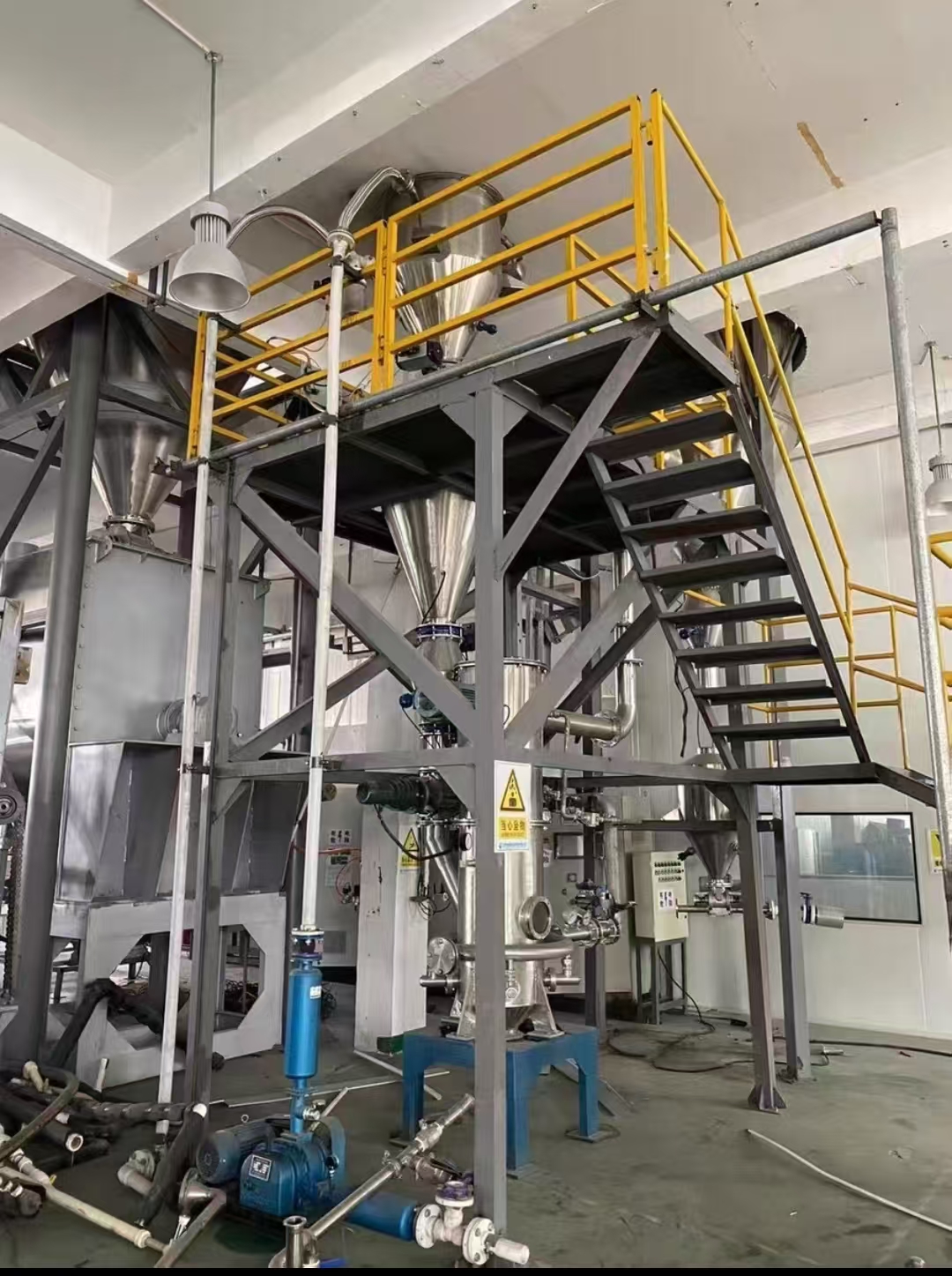
II. The air jet mill in the lithium battery material processing 5 core advantages
1.Zero metal pollution guarantee
Full ceramic lining design (zirconia / silicon carbide) combined with the principle of media-free crushing, completely eliminate the introduction of Fe, Cr and other impurities, in line with the requirements of GB/T 33822-2017 standards.
2.Precise particle size control technology
Adopting TurboClassifier® grading system, through the adjustment of rotational speed (2000-12000rpm) to realize the precise control of D97=3-45μm, to meet the needs of different battery systems:
○ Power battery: D50=8-12μm (high rate performance)
○ Power battery: D50=8-12μm (high rate performance) ○ Energy storage battery: D50=15-20μm (balance between processability and cycle life)
3. Thermal material protection mechanism
Built-in gas circulation cooling module to ensure that the temperature of the crushing chamber ≤ 45 ℃, to prevent the NCM material phase change during processing.
4.Intelligent production integration
Realized by PLC+SCADA system:
○ Online particle size monitoring (laser diffraction technology)
○Automatic adjustment of gas-solid ratio (error <±3%)
○ Fault warning accuracy>92%.
5. Environmental protection and cost advantages
Compared with traditional equipment:
○ Energy consumption reduced by 40% (average 2.8kW-h/kg)
○ Raw material utilization rate increased to 99.3%.
○ Maintenance cycle extended to 2000 hours
III. The forefront of the industry: the 3 major innovation direction of air jet mill technology
1. Hydrogen energy drive system
Experiments have proved that the use of hydrogen as a pulverizing medium can increase production capacity by 25%, while reducing CO2 emissions (Japan's JFE Engineering has verified the feasibility of this technology).
2.AI dynamic optimization model
Based on the material hardness, humidity and other parameters to adjust the nozzle angle and air pressure value in real time, a German equipment manufacturer has realized the fluctuation rate of pulverization efficiency <5%.
3.Nanoscale preparation breakthrough
Composite design (air flow pulverization + plasma treatment) successfully prepared 50nm grade single crystal NCM811 material, specific capacity increased to 215mAh/g.
Conclusion: Pulverization process determines the material ceiling
In the recent technology roadmap of Ningde Times, LG New Energy and other headline companies, the air jet mill is clearly listed as the necessary equipment for ternary material production line upgrade. With the continuous breakthroughs of equipment manufacturers in grading precision (target D90≤2μm) and energy consumption control (target 1.5kW-h/kg), the global market size is expected to reach $780 million in 2025, with a compound annual growth rate of 18.3%. Choosing the appropriate crushing solution has become a key battle for anode material companies to build a technological moat.