Air Jet Mill Ultra-Fine Grinding Process
Common air jet milling crushing processes mainly include: air jet crushing process, superheated steam crushing process, and inert gas crushing process, etc., which are generally equipped with high-pressure air jet or superheated steam generating devices.
1. Air jet Milling Process
Figure 1-1 shows the process flow diagram of the ambient temperature jet milling process for a disc-type jet mill. The main feature of this process layout is that compressed air is cooled and dehumidified before undergoing oil and water removal. This is because oil and water in compressed air not only contaminate the product but may also cause moisture-laden materials to clog the milling system. If an oil-free lubricated air compressor is used, only water removal is necessary.
This process flow is suitable for materials with strict moisture content requirements. When grinding materials with less stringent moisture content requirements, certain purification steps in the process can be omitted. If the amount of waste gas carried by the airflow is not significant, or if the amount is large but the filter area of the baghouse dust collector (12) is sufficient, the cyclone separator (11) can also be omitted. In some cases, the exhaust gas stream from the jet mill already has sufficient pressure to overcome the resistance of the baghouse dust collector, in which case the exhaust fan (13) can also be omitted.
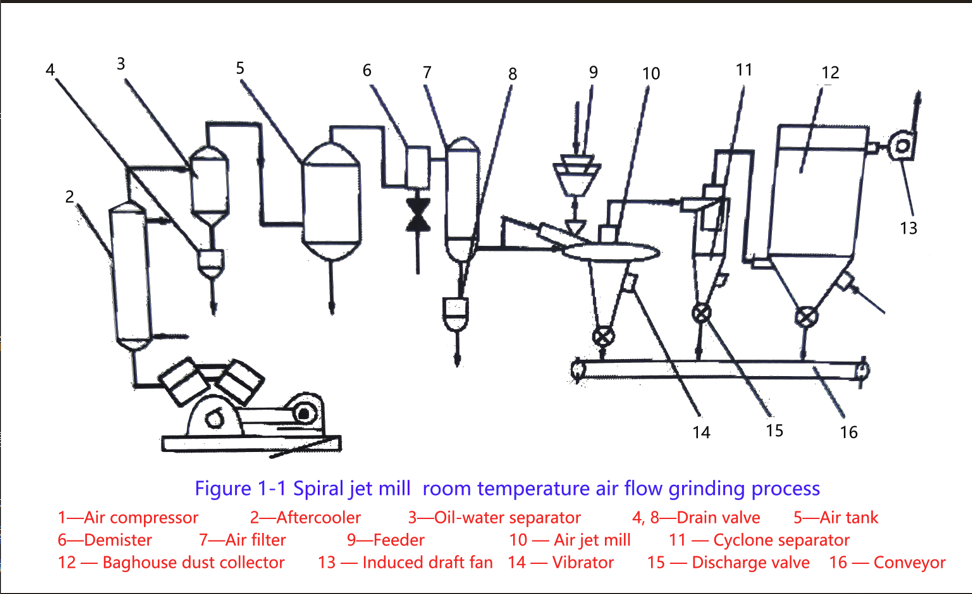
Sometimes, grinding must be performed at low temperatures, such as when grinding certain low-melting-point or heat-sensitive materials. In such cases, low-temperature air is required, and the above process must be supplemented with an air cooler, etc. In certain situations, such as combined drying and grinding, grinding and oxidation reactions, or combined grinding and surface treatment, a hot air flow is required. In such cases, the process must be supplemented with a heater, etc.
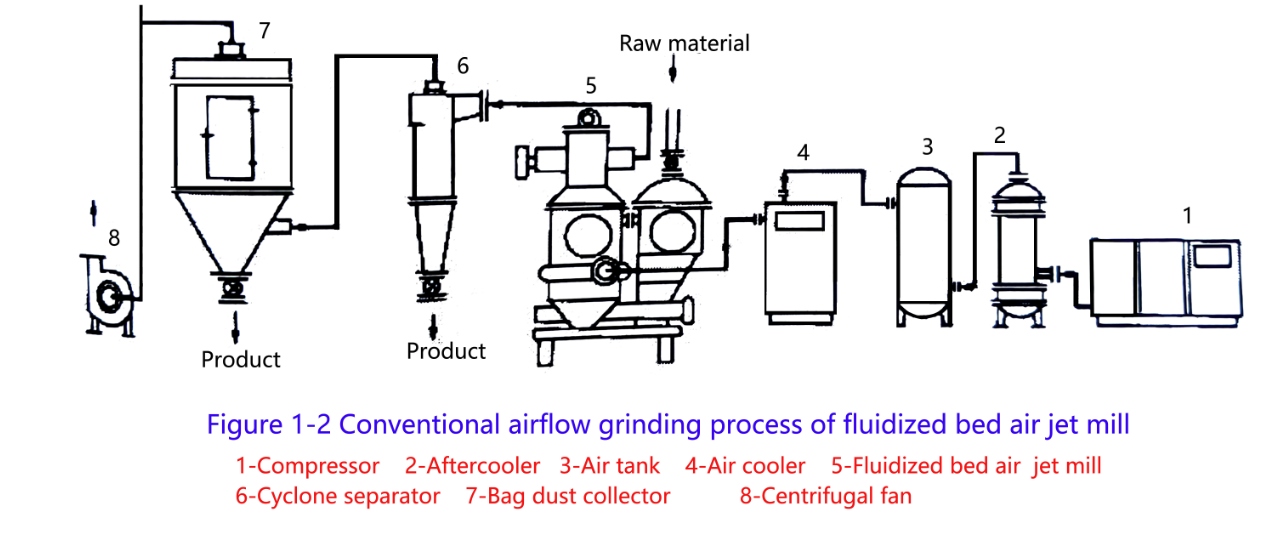
Figure 1-2 below shows the normal temperature air flow grinding process of a fluidized bed air jet mill. The characteristic of this process is that a fine classifier is installed at the top of the grinding chamber of the fluidized bed air jet mill, which can control the particle size distribution of the product.
2. Superheated Steam Grinding Process
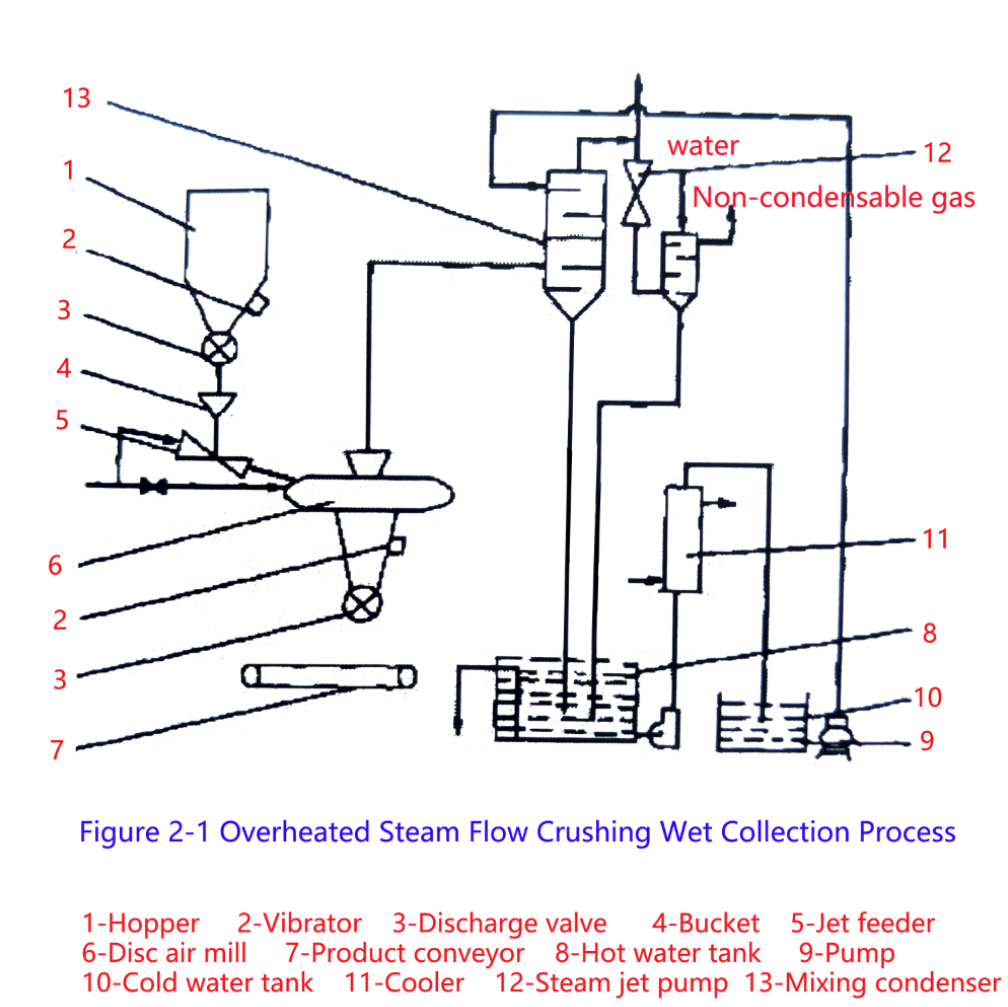
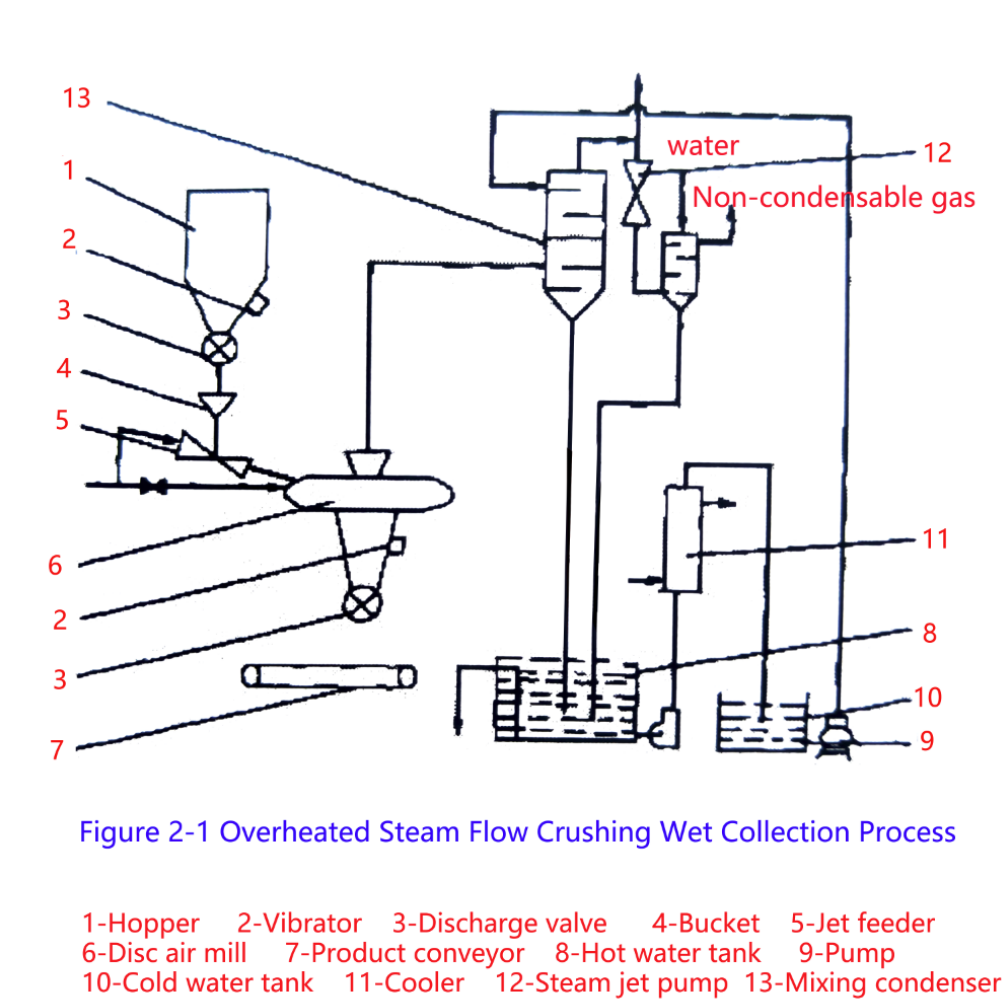
Figure 2-1 shows the process flow of the superheated steam wet collection process. Disc-type air jet mill (6) is an upper exhaust and lower discharge type; superheated steam is 250–400°C (optimal range is 250–290°C); pressure is 686–1372 kPa (optimal range: 1078–1176 kPa). The waste steam enters the waterfall-type mixing condenser 13, where it is condensed by cold water from the cold water tank 10. The collected product settles to the bottom of the hot water tank 8, is extracted in slurry form, and undergoes further processing. The clarified hot water is cooled in the cooler 11 and then enters the cold water tank 10, from which it is pumped to the condenser 13. The steam that has not been condensed is extracted by the steam jet pump 12 and further condensed.
3. Process Characteristics Jet Milling Process
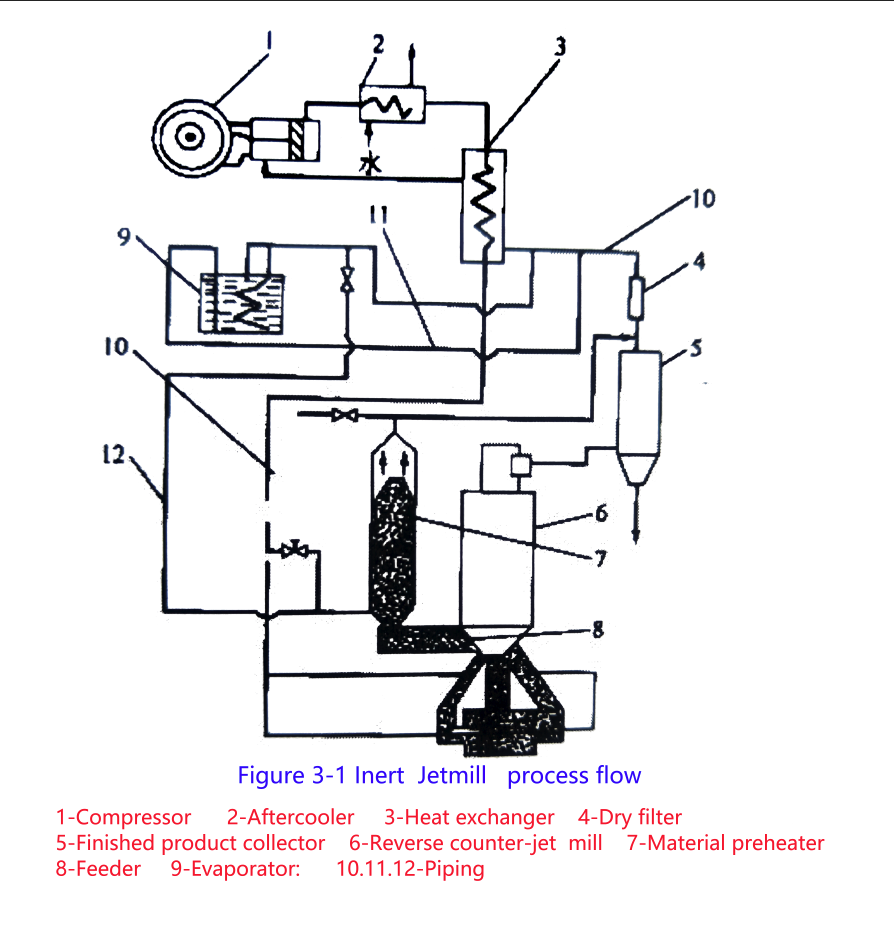
For certain materials with extremely low melting points or high thermal sensitivity, such as special resins and chemicals, using air can cause product oxidation, so inert gases like nitrogen or carbon dioxide must be used. In this case, the process layout is designed to ensure the recovery and reuse of inert gases. The process flow shown in Figure 3-1 has this characteristic.
The airflow from the compressor (1) is cooled by a coolant and then enters the heat exchanger (3). The cooled exhaust gas and the cold supplementary airflow from the evaporator (9) are further cooled. The cooled airflow is then divided into two paths: one path enters the material cooler to make the material brittle and improve its crushability; the other path enters the nozzle of the airflow mill (6). The material carried by the exhaust gas stream enters the product collector (5) for gas-solid separation. The exhaust gas stream, which has absorbed moisture from the material and may carry trace amounts of dust, passes through the drying filter (4) for moisture absorption and filtration. The filtered gas stream either directly enters the heat exchanger (3) or goes to the evaporator (9) to heat liquid volatile substances. After vaporizing into a gaseous state, it returns to the compressor (1) along with the new volatile gas stream via the heat exchanger (3). The liquid substances in the evaporator (9) are primarily used to compensate for normal gas stream losses. This system should operate under strict insulation conditions.