3D Powder Mixer Manufacturer | SWH Series | JETER
Three-Dimensional Mixing for Uniform Powder Blending
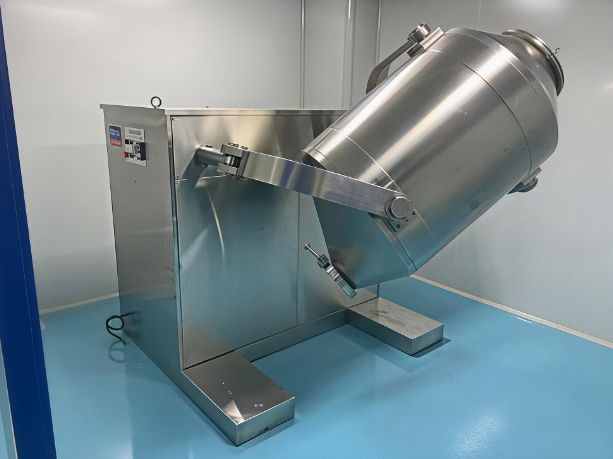
The JETER SWH Series 3D Powder Mixer is designed for batch blending of dry powders and granules that require consistent material distribution. Its three-dimensional movement drives the mixing vessel through a continuous alternating motion, allowing materials to move in different directions throughout the mixing process.
Unlike conventional mixers that rely mainly on a rotating shaft or fixed mixing blades, a 3D powder mixer uses the movement of the entire mixing vessel to redistribute the materials. This creates repeated material exchange within the container and helps achieve a uniform blend.
The SWH Series features a fully enclosed mixing chamber, compact transmission structure and a range of models suitable for different batch sizes. Available vessel volumes range from 5 L to 1,500 L, with loading volumes from 3 L to 1,200 L.
The equipment is suitable for evaluating powder and granule blending applications in the pharmaceutical, chemical, food, ceramic and advanced materials industries.
JETER provides 3D powder mixing equipment for laboratory-scale, pilot-scale and industrial batch processing requirements.
Key Features of the SWH Series 3D Powder Mixer
1. Three-Dimensional Mixing Motion
The mixing vessel follows a specially designed alternating cyclic movement, creating continuous material redistribution inside the container.
This movement allows powder particles to exchange positions throughout the mixing space rather than relying on a single fixed mixing direction.
It is particularly useful for evaluating formulations containing multiple powder components with different particle sizes or bulk densities.
2. Fully Enclosed Mixing Chamber
The mixing container operates as an enclosed vessel during processing.
This design helps contain powder materials, reduce dust escape and limit exposure to the surrounding production environment.
The enclosed structure is especially relevant when handling fine powders or materials that require controlled processing conditions.
3. High Loading Volume
The SWH Series offers loading volumes of up to approximately 80% of the nominal cylinder volume, according to the supplied model specifications.
A suitable loading level is important because sufficient internal space is required for the materials to move and redistribute during mixing.
The actual loading quantity should be determined according to bulk density, particle characteristics and the required mixing result.
4. Short Batch Mixing Cycles
The listed mixing times for the SWH Series range from 5 to 22 minutes, depending on the selected model.
Actual mixing time depends on the formulation, material properties, loading level and required blend uniformity.
For new formulations, a mixing trial is recommended to establish the appropriate operating time.
5. Multiple Models for Different Production Scales
The SWH Series includes 12 models with nominal vessel volumes from 5 L to 1,500 L.
This range allows customers to select equipment according to their batch requirements, available installation space and production objectives.
6. Stable Operation and Low Noise
The equipment uses a dedicated transmission system to drive the mixing vessel through its designed movement pattern.
Its structure is intended for stable operation and relatively low operating noise under suitable installation and operating conditions.
What Is a 3D Powder Mixer?
A 3D Powder Mixer, also known as a Three-Dimensional Mixer or 3D Blender, is a batch mixing machine that uses compound movement of the mixing vessel to blend different powder materials.
During operation, the vessel follows an alternating cyclic motion, continuously changing the position and distribution of the materials inside.
This repeated movement promotes material exchange throughout the mixing chamber and helps reduce localized concentration of individual ingredients.
A 3D mixer is commonly considered when:
Different powder ingredients need to be blended in one batch.
Materials have different particle sizes or bulk densities.
A fully enclosed mixing process is preferred.
Gentle material handling is an important consideration.
A compact batch mixing machine is required.
The actual mixing performance depends on material properties, loading conditions and operating parameters. A trial using the customer's actual materials is the most reliable way to establish the required mixing time and blend uniformity.
Working Principle of a Three-Dimensional Powder Mixer
The SWH Series works through the compound movement of its mixing vessel rather than conventional internal agitator blades.
Step 1: Material Loading
Different powder ingredients are introduced into the mixing container according to the required formulation.
The loading quantity should remain within the recommended loading volume to allow sufficient space for material movement.
Step 2: Three-Dimensional Vessel Movement
After loading, the mixing vessel is driven by the transmission system and follows its designed alternating cyclic movement.
This movement continuously changes the orientation and position of the powder inside the container.
Step 3: Material Redistribution
As the vessel moves, powder particles travel through different areas of the mixing chamber.
Repeated material exchange helps distribute individual ingredients throughout the batch.
Step 4: Mixing Completion
The mixing process continues for the required operating time.
The final mixing time should be established through material testing and evaluation of the required blend uniformity.
Step 5: Discharge
After mixing is completed, the finished material is discharged for subsequent processing, storage or packaging.
The discharge arrangement should be selected according to the material's flowability and production requirements.
Main Components of the SWH 3D Mixer
Mixing Container
The mixing container holds the materials during processing.
Its internal geometry and surface finish influence material movement, cleaning and material discharge.
The container volume and loading volume are important factors when selecting the appropriate model.
Transmission System
The transmission system drives the mixing vessel through the designed three-dimensional movement.
It is an important part of the machine's overall operating stability and mechanical performance.
Drive Motor
The motor supplies the power required for the mixing movement.
Motor power varies according to the selected SWH model, ranging from 0.12 kW to 11 kW.
Machine Base and Support Structure
The supporting structure carries the mixing assembly and transmission components.
The equipment should be installed on a suitable foundation according to its dimensions, operating weight and installation requirements.
Discharge Arrangement
The discharge system allows the finished powder mixture to be removed from the container.
The outlet design should consider material flow characteristics, residual material requirements and downstream production arrangements.
Industrial Applications of 3D Powder Mixers
The SWH Series can be evaluated for a wide range of dry powder and granule blending applications.
Pharmaceutical Industry
Potential applications include:
Pharmaceutical excipients
Dry powder formulations
Selected pharmaceutical intermediates
Multi-ingredient powder blends
For pharmaceutical production, material-contact surfaces, cleaning procedures and process validation requirements should be confirmed according to the customer's quality system.
Chemical Industry
Typical applications include:
Fine chemical powders
Chemical additives
Pigments and functional powders
Specialty chemical ingredients
Multi-component chemical formulations
Material compatibility and potential contamination requirements should be considered when selecting the contact materials.
Food and Nutritional Ingredients
Potential applications include:
Food ingredient powders
Nutritional premixes
Powdered additives
Dry food formulations
Selected functional ingredients
The material-contact construction and cleaning arrangements should match the actual food production requirements.
Ceramic and Advanced Materials
The equipment can be evaluated for:
Ceramic powder formulations
Inorganic material blends
Mineral-based powders
Selected specialty material mixtures
For applications involving fragile particles or strict particle morphology requirements, the effect of mixing should be assessed through testing.
SWH Series 3D Powder Mixer – Technical Specifications
The JETER SWH Series includes 12 models designed for different batch sizes and production requirements.
The following table presents the original model specifications.
Model and Technical Data
| Model | Cylinder Volume (L) | Loading Volume (L) | Loading Weight (kg) | Speed (rpm) | Mixing Time (min) | Power (kW) | Dimensions (mm) | Weight (kg) |
|---|---|---|---|---|---|---|---|---|
| SWH-5 | 5 | 3 | 1.5 | 15 | 5–22 | 0.12 | 450 × 500 × 650 | 100 |
| SWH-10 | 10 | 8 | 4 | 15 | 5–15 | 0.18 | 500 × 550 × 700 | 150 |
| SWH-25 | 25 | 20 | 10 | 17 | 5–15 | 0.55 | 900 × 900 × 1000 | 300 |
| SWH-50 | 50 | 40 | 20 | 17 | 5–15 | 0.75 | 900 × 1000 × 1220 | 500 |
| SWH-100 | 100 | 80 | 40 | 12 | 5–15 | 1.5 | 1100 × 1300 × 1250 | 800 |
| SWH-200 | 200 | 160 | 80 | 8 | 5–15 | 2.2 | 1300 × 1650 × 1550 | 1200 |
| SWH-300 | 300 | 240 | 120 | 6 | 5–12 | 4 | 1500 × 1800 × 1700 | 1400 |
| SWH-400 | 400 | 320 | 160 | 4 | 5–12 | 4 | 1600 × 2000 × 1800 | 1700 |
| SWH-600 | 600 | 480 | 240 | 4 | 5–12 | 5.5 | 1700 × 2100 × 1850 | 2100 |
| SWH-800 | 800 | 640 | 320 | 3 | 5–11 | 7.5 | 2100 × 2400 × 2250 | 2400 |
| SWH-1000 | 1000 | 800 | 400 | 3 | 5–11 | 7.5 | 2280 × 2600 × 2500 | 2550 |
| SWH-1500 | 1500 | 1200 | 600 | 3 | 5–11 | 11 | 2500 × 3100 × 2600 | 3100 |
Technical Notes
Cylinder volume refers to the nominal volume of the mixing container.
Loading volume represents the specified material loading volume for each model.
Loading weight is based on the supplied equipment specifications. Actual material weight depends on bulk density.
Rotational speed varies according to the selected model.
Mixing time is a reference range and should be confirmed through material trials.
Motor power and equipment dimensions are based on the supplied model data.
Final specifications should be confirmed against the selected equipment configuration before ordering.
How to Select the Right 3D Powder Mixer
Selecting a 3D powder mixer requires consideration of the required batch weight, material characteristics and production conditions.
1. Determine the Required Batch Weight
Start with the required weight of material per batch.
The same loading volume can correspond to different material weights depending on bulk density.
For example, a 40 L loading volume does not represent the same batch weight for a lightweight powder and a dense mineral powder.
2. Check the Loading Volume
The loading volume is an important selection parameter.
The SWH Series provides different loading volumes from 3 L to 1,200 L.
The actual loading level should allow sufficient internal movement for the materials to redistribute during operation.
3. Evaluate Material Characteristics
Provide the following information:
Material name
Bulk density
Particle size distribution
Moisture content
Flowability
Number of ingredients
Differences in particle size and density
These properties help determine whether the three-dimensional mixing principle is suitable for the formulation.
4. Establish the Required Mixing Time
Different materials may require different mixing times.
The listed values are reference ranges rather than guaranteed processing times for every formulation.
For applications requiring strict blend uniformity, samples should be collected from different locations in the batch and evaluated using an appropriate testing method.
5. Consider Cleaning and Material Contact
For pharmaceutical, food and specialty chemical applications, material-contact requirements should be confirmed before ordering.
Discuss the required contact material, internal surface finish, cleaning procedure and any cross-contamination control requirements.
6. Confirm Installation Conditions
Check the overall dimensions, equipment weight, available floor space and electrical supply before confirming the model.
For larger SWH models, installation access and the supporting foundation should also be considered.
3D Powder Mixer vs. V-Shape Mixer vs. Double Cone Mixer
These three types of equipment are used for batch powder blending, but they use different mixing vessel geometries and movement patterns.
| Comparison | 3D Powder Mixer | V-Shape Mixer | Double Cone Mixer |
|---|---|---|---|
| Mixing Principle | Three-dimensional vessel movement | Rotating V-shaped vessel | Rotating double-cone vessel |
| Material Movement | Compound alternating motion | Splitting and merging of material | Tumbling and redistribution |
| Mixing Mechanism | Movement of the complete vessel | Gravity-driven tumbling | Gravity-driven tumbling |
| Typical Application | Batch powder and granule blending | Dry powder blending | Dry powder and granule blending |
| Selection Focus | Batch size, loading level and vessel movement | Material flow and batch uniformity | Material characteristics and discharge |
The appropriate mixer depends on the formulation, required batch size, material characteristics and cleaning requirements.
For materials with significant differences in particle size or bulk density, mixing trials are recommended before finalizing the equipment selection.
Integration into a Complete Powder Processing Line
A 3D Powder Mixer can operate as an independent batch mixing machine or be incorporated into a larger powder processing system.
Depending on the production process, it may be integrated with:
Raw material feeding systems
Weighing and dosing equipment
Vacuum conveying systems
Jet mills and air classifiers
Screening equipment
Storage and packaging systems
When designing an integrated system, material transfer, batch sequencing, equipment capacity and dust control should be considered together.
JETER provides individual powder processing machines and coordinated equipment solutions for different industrial production requirements.
Frequently Asked Questions
What is a 3D powder mixer used for?
A 3D powder mixer is used for batch blending of dry powders and granules. Its three-dimensional vessel movement promotes material redistribution and helps achieve a uniform mixture.
What is the difference between a 3D powder mixer and a conventional powder mixer?
A conventional mixer often uses internal rotating blades or ribbons to move materials. A 3D powder mixer uses the movement of the complete mixing vessel to redistribute materials inside the container.
What is the maximum loading volume of the SWH Series?
The SWH-1500 has a nominal cylinder volume of 1,500 L and a specified loading volume of 1,200 L.
How long does a 3D powder mixer take to complete mixing?
The listed mixing times for the SWH Series range from 5 to 22 minutes, depending on the model. Actual processing time depends on the material and required mixing result.
Can a 3D powder mixer blend materials with different particle sizes?
The equipment is designed for mixing materials with different particle sizes and specific gravities. However