Industrial Spray Dryer Manufacturer | LPG Series | JETER
Industrial Spray Dryer
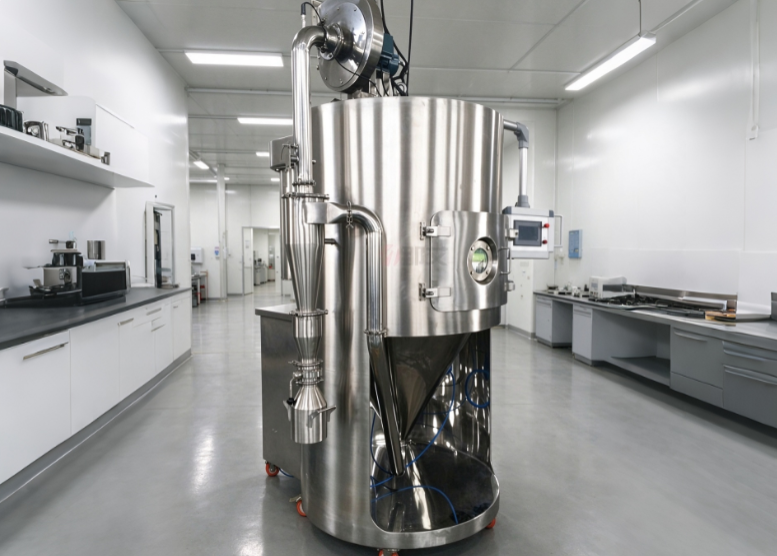
Customized Spray Drying Systems for Liquid-to-Powder Processing
JETER industrial spray dryers are designed to convert liquid feed materials into dry powders or particles through controlled atomization and rapid contact with heated drying air.
The equipment can process a range of liquid materials, including solutions, emulsions, suspensions and other pumpable feed products. During operation, the liquid is dispersed into droplets and brought into contact with heated air inside the drying chamber. Moisture evaporates rapidly, and the resulting powder is collected through the configured separation and collection system.
JETER provides spray drying equipment with different atomization options, heating configurations and system layouts. The equipment can be selected or customized according to feed properties, evaporation requirements, powder characteristics and production conditions.
For heat-sensitive materials, customized low-temperature spray drying configurations are also available following process evaluation.
Typical applications: Pharmaceutical ingredients, food ingredients, chemical products, battery materials, minerals and advanced materials.
Key Features of JETER Spray Dryers
Flexible Atomization Configurations
Different materials require different atomization conditions. JETER spray dryers can be configured with different atomization technologies according to the selected model and process requirements.
Depending on the application, the system may use centrifugal atomization or another suitable atomization method. The final configuration is determined by factors such as feed viscosity, solids content, target particle size, powder morphology and required evaporation capacity.
Rapid Liquid-to-Powder Processing
Spray drying disperses liquid feed into droplets, creating a large contact area between the material and heated air. This supports rapid moisture evaporation and continuous powder production.
The actual drying performance depends on the feed formulation, droplet characteristics, operating temperatures and system configuration.
Multiple Heating Options
JETER spray dryers can be configured with different heating arrangements to suit site utilities and process requirements, including:
Electric heating
Steam heating combined with electric heating
Thermal oil heating
Gas heating
Hot air furnace heating
The suitable heating method depends on the required thermal duty, available energy source, operating cost and plant conditions.
Customized Low-Temperature Spray Drying
For heat-sensitive materials, JETER can provide customized low-temperature spray drying configurations.
The process is evaluated according to material thermal sensitivity, feed properties, required final moisture, powder characteristics and production capacity. Operating temperatures and system arrangements are determined for the specific application rather than assumed to be the same for every material.
Automatic Temperature Control
The spray drying system can be equipped with temperature monitoring and control to manage operating conditions.
The control arrangement and instrumentation are selected according to the equipment configuration and the customer's process requirements.
Integrated Powder Collection
The drying chamber can be combined with suitable powder separation and collection equipment, such as cyclones and bag filters, according to the material properties and required recovery arrangement.
The final collection system should be designed around powder characteristics, exhaust conditions and applicable environmental requirements.
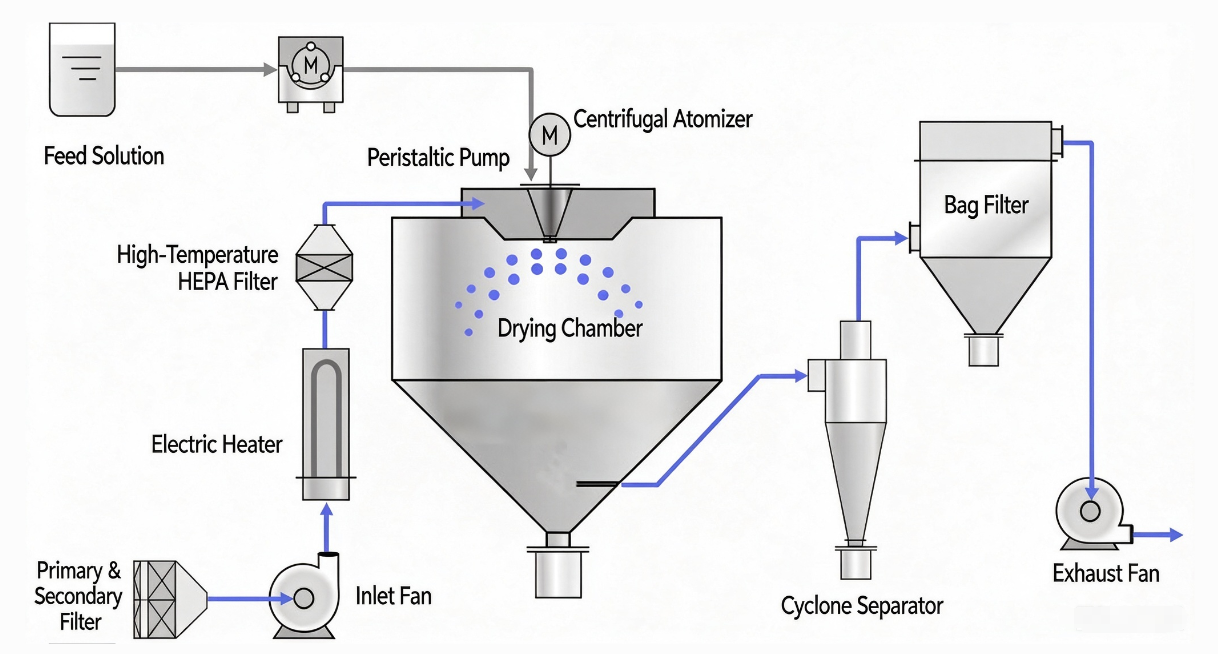
How Does an Industrial Spray Dryer Work?
Spray drying converts a liquid feed into powder through atomization, hot-air contact, moisture evaporation and powder collection.
1. Feed Preparation
The liquid material is prepared and conditioned before entering the spray dryer. Depending on the application, preparation may include mixing, filtration, concentration adjustment or temperature conditioning.
Feed viscosity, solids content and stability should be checked because they influence atomization and drying performance.
2. Liquid Atomization
A feed delivery system transfers the liquid to the atomization device, where it is dispersed into droplets.
The atomization technology is selected according to the model and material requirements. Centrifugal atomization is one available configuration; other atomization methods may be selected for suitable applications.
3. Hot-Air Supply
Air passes through the selected air treatment and heating arrangement before entering the drying chamber.
The inlet air temperature is controlled according to the material and process requirements. The air distribution arrangement is designed to support contact between the heated air and atomized droplets.
4. Droplet Drying
The atomized droplets contact the heated air inside the drying chamber. Moisture evaporates as the droplets travel through the chamber, and dried particles are formed.
The final powder properties are influenced by feed composition, droplet size, inlet and outlet temperatures, residence time and other operating conditions.
5. Powder Separation and Collection
The dried material is separated from the exhaust air through the configured collection system.
Depending on the design, powder may be collected from the drying chamber and downstream separation equipment. Exhaust gas treatment is selected according to the material and applicable site requirements.
6. Product Discharge
The collected powder is discharged for subsequent storage, screening, blending or packaging.
The discharge and conveying arrangements can be adapted to the required production process.
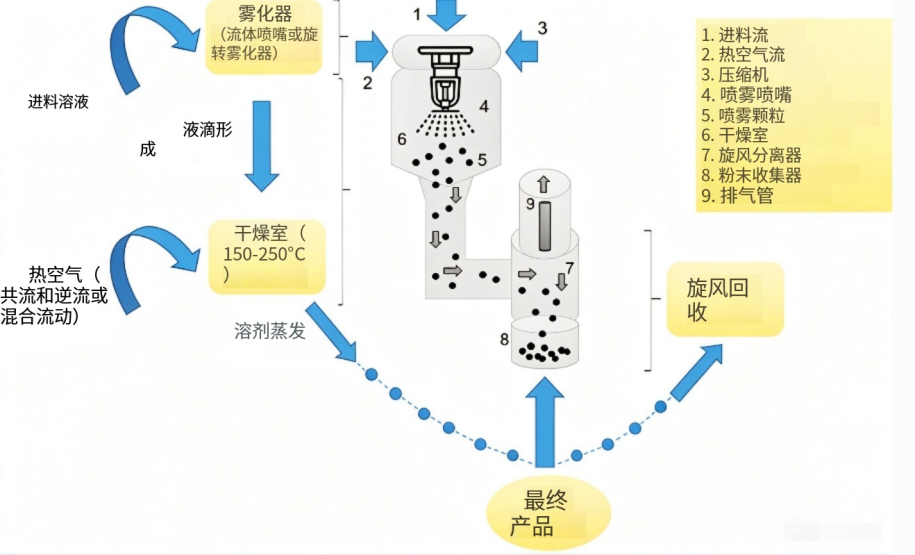
Main Components of a Spray Drying System
A spray drying system is made up of several coordinated sections. The exact equipment arrangement varies according to model, atomization method and process requirements.
Feed Preparation and Delivery System
This section stores, prepares and transfers the liquid feed to the atomization device.
The pump and feed line should be selected according to feed viscosity, flow rate, solids content and material compatibility.
Atomization System
The atomization system disperses the liquid into droplets. Its design has a direct influence on droplet size and the resulting powder characteristics.
JETER selects the atomization arrangement according to the application rather than applying one configuration to every model.
Drying Chamber
The drying chamber provides the space for contact between atomized droplets and heated air.
Its dimensions and internal arrangement are selected according to evaporation capacity, airflow conditions and the required drying process.
Air Heating and Distribution System
This section heats and distributes the drying air. The heating source can be selected according to available utilities and process requirements.
Powder Separation and Collection System
Cyclones, bag filters or other suitable collection equipment may be incorporated depending on the system design.
The collection arrangement should consider powder recovery, exhaust conditions, dust control and material characteristics.
Exhaust and Control System
The exhaust arrangement handles the air leaving the drying process. Temperature monitoring and control instruments help operators manage the selected operating conditions.
The level of automation and instrumentation can be configured according to project requirements.
Industrial Applications of Spray Dryers
Spray drying is used in industries where liquid materials need to be converted into powders with controlled moisture content and physical characteristics.
Pharmaceutical Industry
Potential applications include:
Pharmaceutical intermediates
Selected active ingredient solutions and suspensions
Pharmaceutical excipients
Herbal extracts
Other process-compatible liquid formulations
For pharmaceutical applications, the equipment design should be reviewed against the required material-contact standards, cleaning procedures, containment measures and validation requirements.
Food and Nutritional Ingredients
Potential applications include:
Food ingredient solutions
Plant extracts
Flavoring and functional ingredient preparations
Nutritional ingredients
Other suitable food-grade liquid formulations
The final system configuration should reflect the material's thermal sensitivity, hygiene requirements and target powder properties.
Chemical Industry
Potential applications include:
Specialty chemical solutions
Pigment and dye preparations
Chemical additives
Functional material suspensions
Other process-compatible chemical liquids
Material compatibility, solvent characteristics and process safety requirements should be assessed before equipment selection.
Battery and Advanced Materials
Spray drying may be considered for selected battery material precursors, ceramic suspensions and advanced material formulations that require conversion from a liquid feed into powder.
The suitability of the process depends on the formulation, particle requirements, thermal characteristics and downstream production process. Material trials may be necessary to establish the appropriate operating conditions.
Mineral and Inorganic Materials
Potential applications include suitable mineral slurries, inorganic suspensions and other liquid-based material preparations.
Feed solids content, particle characteristics, abrasion and required powder properties should be considered during system design.
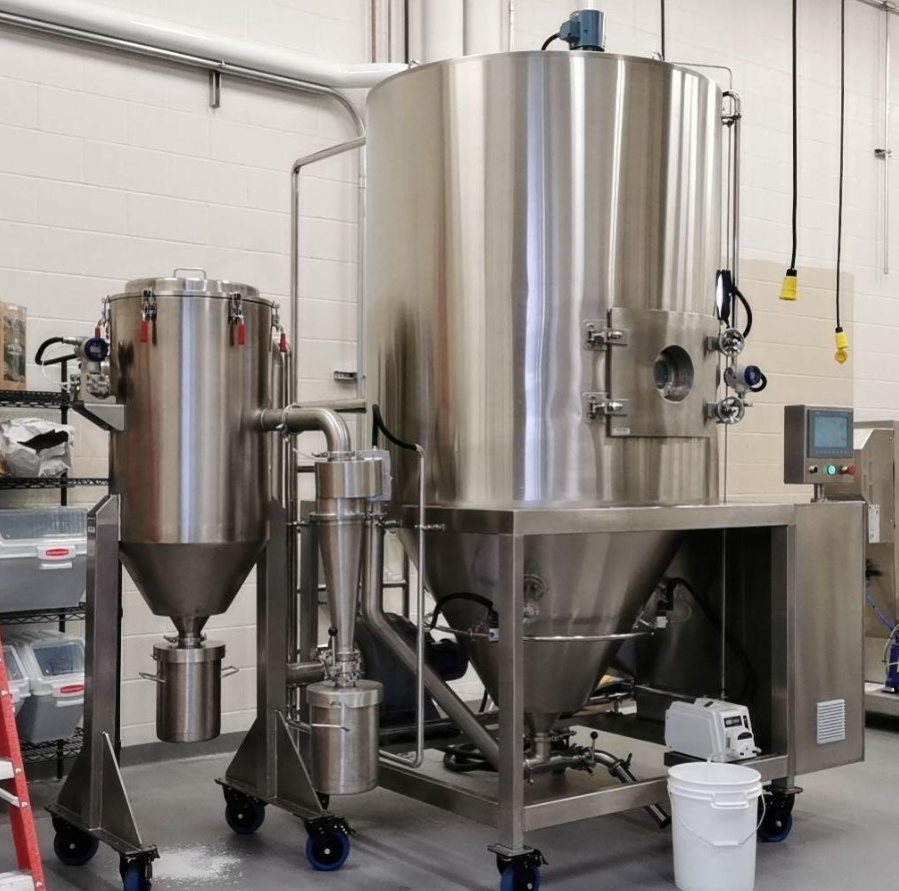
JETER Spray Dryer – LPG Series Technical Specifications
The following table presents the available reference data for the JETER LPG Series. Final model specifications and configurations should be confirmed against the selected project.
| Model | Water Evaporation Capacity (kg/h) | Atomizer Speed (rpm) | Atomizer Wheel Diameter (mm) | Power (kW) |
|---|---|---|---|---|
| LPG-5 | 5 | To be confirmed | 50 | 9 |
| LPG-25 | 25 | 18,000 | 120 | 36 |
| LPG-50 | 50 | 18,000 | 120 | 63 |
| LPG-100 | 100 | 18,000 | 140 | 114 |
| LPG-150 | 150 | 15,000 | 150 | 144 |
| LPG-200-2000 | 1,200–2,000 | 8,000–15,000* | 180–240* | To be confirmed |
Technical notes:
Water evaporation capacity refers to the approximate amount of water that can be evaporated per hour under specified operating conditions. It is not the finished powder production rate.
Actual powder output depends on feed rate, feed solids content, final moisture content and process conditions.
Atomizer speed and wheel diameter are applicable to the corresponding centrifugal atomization configuration. They should not be interpreted as specifications for every atomization option.
The LPG-5 atomizer speed requires further confirmation and is therefore not stated as a confirmed value.
The LPG-200-2000 power rating has not yet been inserted because the verified value has not been provided.
The LPG-200-2000 atomizer speed and wheel diameter should be confirmed against the final configuration before publication as fixed specifications.
Model dimensions and auxiliary equipment arrangements for larger systems are project-specific and should be confirmed during engineering design.
Operating Temperature and Heating Options
The reference operating data currently available for the LPG Series include:
| Parameter | Reference Range or Option |
|---|---|
| Inlet air temperature | 140–350°C |
| Outlet air temperature | 80–90°C |
| Temperature control | Automatic control, according to configuration |
| Heating options | Electricity, steam + electricity, thermal oil, gas or hot air furnace |
These values are reference information, not universal operating settings for every material. Actual inlet and outlet temperatures must be established according to feed properties, thermal sensitivity, required final moisture and powder quality.
For heat-sensitive materials, JETER can evaluate a customized low-temperature spray drying configuration.
Customized Low-Temperature Spray Drying Solutions
Some materials may be affected by excessive thermal exposure during drying. These applications require careful evaluation of the material's temperature sensitivity and the overall drying process.
JETER can customize low-temperature spray drying configurations according to the customer's material and production requirements.
The engineering evaluation may consider:
Material thermal sensitivity
Feed concentration and solids content
Feed temperature and viscosity
Required inlet and outlet air temperatures
Target final moisture content
Desired particle size and powder morphology
Production capacity and collection requirements
Low-temperature spray drying is not a single fixed operating temperature or standard configuration. The actual system design and process parameters need to be determined for each material.
Customers are encouraged to provide material information and, where possible, sample materials for process evaluation.
How to Select the Right Spray Dryer
Selecting a spray dryer involves more than matching a model number to a required evaporation capacity. The feed material, powder requirements and production conditions all influence the equipment configuration.
1. Confirm the Feed Material
Provide the material name and describe whether it is a solution, emulsion, suspension or another pumpable liquid.
Important information includes viscosity, solids content, density, pH, solvent characteristics and thermal sensitivity.
2. Define the Required Processing Capacity
Clarify the required feed rate and water evaporation rate.
Water evaporation capacity should not be confused with finished powder output. The powder output also depends on the solids content of the feed and the final moisture requirement.
3. Determine the Atomization Method
The suitable atomization method depends on material properties and target powder characteristics.
Feed viscosity, particle size requirements, production capacity and desired powder morphology should be considered before selecting the configuration.
4. Establish the Powder Requirements
Define the target particle size range, moisture content, bulk density, flowability and other important product characteristics.
Where these requirements are critical, process testing is recommended before finalizing the equipment.
5. Select the Heating Method
The heating source should be selected according to available utilities, energy costs, required thermal duty and site conditions.
6. Evaluate Powder Collection and Exhaust Treatment
The collection system should match the powder's physical properties and the required recovery and exhaust treatment arrangements.
For fine powders or materials with special handling requirements, dust control and appropriate safety measures should be included in the project evaluation.
7. Consider Cleaning, Materials and Automation
For pharmaceutical, food and specialty chemical production, confirm the required contact materials, surface finish, cleaning method, instrumentation and automation level.
The final design should be aligned with the customer's production standards and applicable regulations.
Spray Dryer vs. Other Industrial Drying Equipment
Spray dryers are designed for converting suitable liquid feeds directly into powders. Other drying equipment may be more appropriate for wet solids, granules or materials requiring different drying conditions.
| Equipment | Typical Feed Material | Main Processing Purpose |
|---|---|---|
| Spray Dryer | Solutions, emulsions and pumpable suspensions | Converts liquid feed into powder |
| Fluid Bed Dryer | Wet powders and granules | Dries particles using controlled hot air |
| Vacuum Dryer | Suitable wet materials requiring reduced-pressure drying | Removes moisture under vacuum |
| Hot Air Dryer | Suitable solids and materials | Removes moisture using heated air |
The appropriate equipment depends on the initial material state, required product form, thermal sensitivity, moisture removal target and downstream process.
Integration into a Complete Powder Processing Line
A spray dryer can operate as an individual processing machine or form part of a larger production line.
Depending on the application, the system may be integrated with:
Liquid preparation and mixing tanks
Feed storage and pumping systems
Filtration and dosing equipment
Spray drying and powder collection systems
Screening and powder classification equipment
Powder mixing systems
Conveying, storage and packaging equipment
Automated process monitoring and control systems
For an integrated line, JETER considers process sequence, material transfer, production capacity, cleaning requirements and plant layout as part of the overall engineering evaluation.
Frequently Asked Questions
What is an industrial spray dryer used for?
An industrial spray dryer converts suitable liquid materials, such as solutions, emulsions and suspensions, into dry powders or particles through atomization and hot-air drying.
Does the JETER LPG Series use only centrifugal atomization?
No. The atomization method depends on the selected model and process requirements. Centrifugal atomization is one available configuration, while other atomization methods can be used for suitable applications.
Can JETER provide low-temperature spray drying?
Yes. JETER can provide customized low-temperature spray drying configurations for suitable heat-sensitive materials. The actual process temperatures and system arrangement are determined according to material properties and product requirements.
What is the difference between water evaporation capacity and powder production capacity?
Water evaporation capacity indicates how much water the dryer can remove per hour under specified conditions. Powder production capacity refers to the amount of finished dry product produced. The latter depends on feed rate, solids content and final moisture content.
Which heating methods are available?
Depending on the selected configuration, heating options may include electricity, steam combined with electricity, thermal oil, gas or a hot air furnace.
Can the spray dryer be customized for a specific material?
Yes. Equipment configuration and process conditions can be evaluated according to feed properties, required capacity, target powder characteristics, heating source and site conditions.
What information is needed for a spray dryer quotation?
To evaluate a project, please provide:
Material name and application
Feed type and available material sample, if possible
Feed rate or required water evaporation capacity
Feed solids content and moisture information
Target powder properties and final moisture
Available heating source and utilities
Required operating conditions and installation location
These details help JETER assess the suitable spray drying configuration and prepare a more relevant technical proposal.
Contact JETER for a Spray Drying Solution
Looking for an industrial spray dryer for pharmaceutical, food, chemical, battery material or other powder production applications?
JETER can help evaluate your material, processing capacity, atomization requirements and drying conditions to develop a suitable spray drying solution.
Contact: [email protected]
WhatsApp: +86 187 1788 3822
Send us your material information and production requirements to discuss a suitable spray dryer configuration.