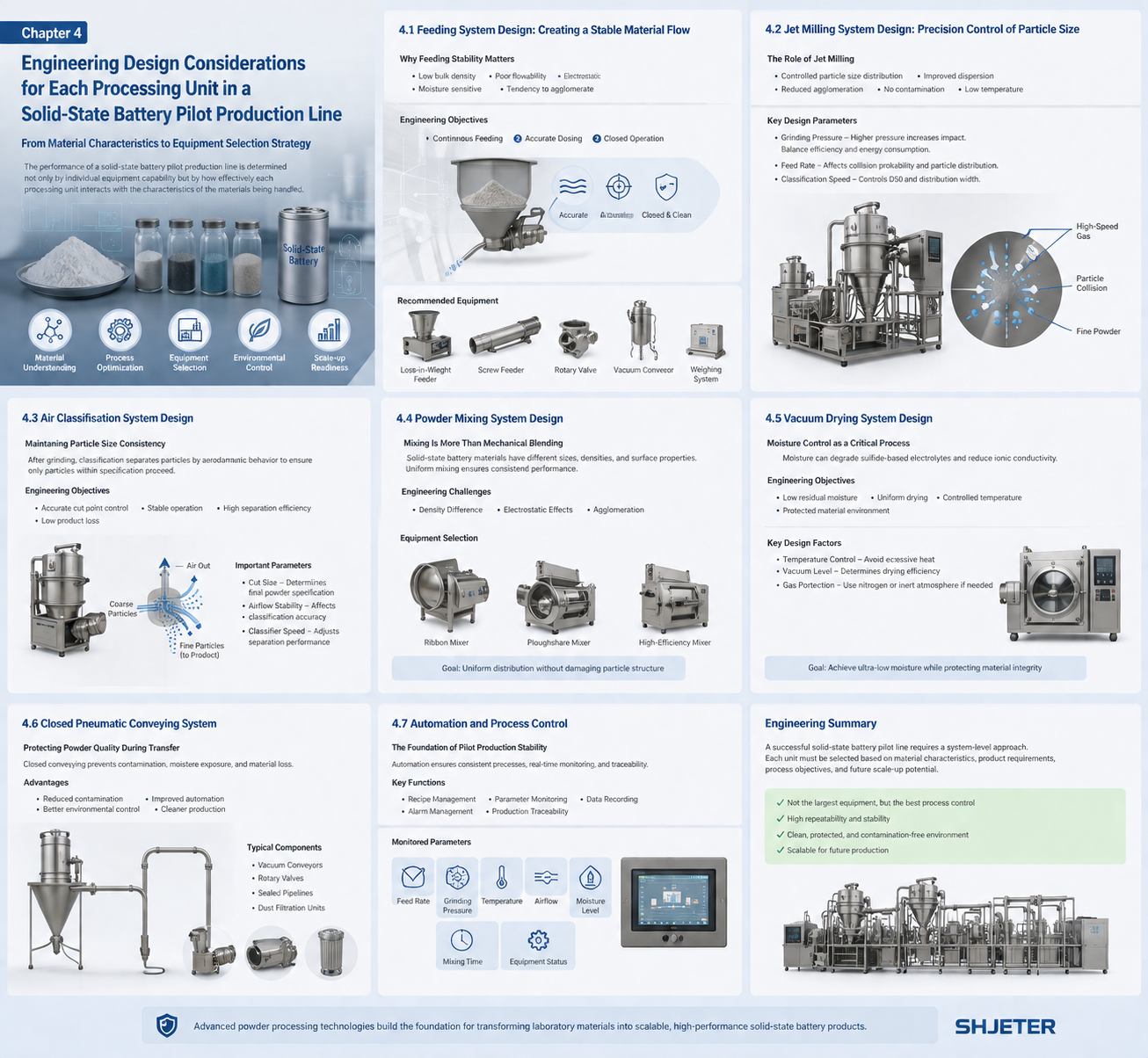
Chapter 4 Engineering Design Considerations for Each Processing Unit in a Solid-State Battery Pilot
From Material Characteristics to Equipment Selection Strategy
The performance of a solid-state battery pilot production line is determined not only by individual equipment capability but by how effectively each processing unit interacts with the characteristics of the materials being handled.
Unlike conventional powder industries, solid-state battery manufacturing involves highly sensitive materials with strict requirements for particle size distribution, moisture control, contamination prevention, and processing consistency.
Therefore, equipment selection cannot follow a simple capacity-based approach.
A larger machine does not necessarily create a better process.
The correct engineering approach is to first understand:
Material properties
Required powder characteristics
Process objectives
Environmental requirements
Future scale-up targets
and then select equipment that can achieve stable and repeatable results.
This chapter discusses the engineering considerations behind each major processing unit used in solid-state battery pilot production lines, including feeding systems, jet mills, air classifiers, mixers, dryers, conveying systems, and automation controls.
4.1 Feeding System Design: Creating a Stable Material Flow
Why Feeding Stability Matters
The first challenge in powder processing is often underestimated: creating a consistent material flow.
Battery materials frequently have:
Low bulk density
Poor flowability
Electrostatic behavior
Moisture sensitivity
Tendency to agglomerate
These characteristics can cause unstable feeding, which directly affects downstream processes.
For example, an unstable feeding rate in a jet milling system may result in:
Particle size fluctuation
Reduced grinding efficiency
Increased energy consumption
Inconsistent product quality
Therefore, the feeding system should be considered as a precision process unit rather than a simple material transportation device.
Engineering Objectives
A properly designed feeding system should achieve:
1. Continuous Feeding
Maintaining a stable material supply prevents process fluctuations.
2. Accurate Dosing
For battery materials, small composition deviations can influence final electrochemical performance.
3. Closed Operation
Closed feeding reduces:
Moisture exposure
Dust emission
External contamination
Recommended Equipment
Typical solutions include:
Loss-in-weight feeders
Screw feeders
Rotary valves
Vacuum conveying systems
Automated weighing systems
The selection depends on:
Powder characteristics
Required accuracy
Production capacity
Material sensitivity
4.2 Jet Milling System Design: Precision Control of Particle Size
The Role of Jet Milling in Battery Material Processing
Particle size engineering is one of the most critical stages in solid-state battery production.
The objective of jet milling is not simply reducing particle size.
The real engineering goal is to achieve:
Controlled particle size distribution
Improved powder dispersion
Reduced agglomeration
Minimal contamination
Stable repeatability
Why Jet Milling Is Suitable for Advanced Battery Materials
Traditional mechanical mills may introduce:
Metal contamination
Excessive heat
Structural damage
Jet mills use high-speed gas flow to accelerate particles and create particle-to-particle collision.
Advantages include:
No grinding media contamination
Low temperature operation
Fine particle production capability
Suitable for sensitive materials
Key Design Parameters
Grinding Pressure
Higher pressure generally increases particle impact energy.
However, excessive pressure may increase:
Energy consumption
Fine particle generation
Operating cost
Feed Rate
The relationship between feed rate and grinding efficiency must be carefully optimized.
Too much feed:
Reduces collision probability
Produces broader particle distribution
Too little feed:
Reduces production efficiency
Classification Speed
Integrated classification determines the final product size.
Adjusting classifier speed allows engineers to control:
D50
D90
Particle distribution width
4.3 Air Classification System Design
Maintaining Particle Size Consistency
After grinding, classification separates particles according to aerodynamic behavior.
A high-efficiency classifier ensures that only particles meeting specification continue to the next production stage.
Engineering Objectives
A properly designed classification system should provide:
Accurate cut point control
Stable operation
High separation efficiency
Low product loss
Important Parameters
Cut Size
The cut size determines the final powder specification.
Airflow Stability
Changes in airflow can influence classification accuracy.
Classifier Speed
Adjusting classifier rotation changes separation performance.
4.4 Powder Mixing System Design
Mixing Is More Than Mechanical Blending
Solid-state battery materials often contain components with very different physical properties:
Active materials
Solid electrolytes
Conductive additives
Binders
These materials must be distributed uniformly without damaging particle structures.
Engineering Challenges
Density Difference
Heavy particles may separate from lighter components.
Electrostatic Effects
Fine powders may adhere to equipment surfaces.
Agglomeration
High-energy mixing may create unwanted clusters.
Equipment Selection
Common mixing technologies include:
Ribbon Mixer
Suitable for general powder blending.
Ploughshare Mixer
Provides intensive mixing with shorter processing time.
Customized High-Efficiency Mixer
Used when battery materials require specific dispersion performance.
4.5 Vacuum Drying System Design
Moisture Control as a Critical Process
For many solid electrolyte systems, especially sulfide-based materials, moisture control is one of the most important engineering challenges.
Water contamination may lead to:
Chemical degradation
Reduced ionic conductivity
Material instability
Engineering Objectives
Vacuum drying systems should achieve:
Low residual moisture
Uniform drying
Controlled temperature exposure
Protected material environment
Key Design Factors
Temperature Control
Avoid excessive temperature that may affect material properties.
Vacuum Level
Determines drying efficiency.
Gas Protection
Nitrogen or inert atmosphere may be required depending on material chemistry.
4.6 Closed Pneumatic Conveying System
Protecting Powder Quality During Transfer
Many production problems do not occur during processing but during transportation between equipment.
Open transfer can introduce:
Humidity
Foreign particles
Material loss
Advantages of Closed Conveying
Reduced contamination risk
Improved automation
Better environmental control
Cleaner production
Typical systems include:
Vacuum conveyors
Rotary valves
Sealed pipelines
Dust filtration units
4.7 Automation and Process Control
The Foundation of Pilot Production Stability
A modern pilot line requires more than mechanical equipment.
Process control systems provide:
Recipe management
Parameter monitoring
Data recording
Alarm management
Production traceability
Important monitored parameters include:
Feed rate
Grinding pressure
Temperature
Airflow
Moisture level
Mixing time
Equipment status
Automation converts individual machines into a complete manufacturing system.
Engineering Summary
The design of a solid-state battery pilot production line requires a system-level approach.
Each processing unit must be selected according to:
Material characteristics
Product requirements
Process objectives
Future production scale
The most successful pilot lines are not necessarily those with the largest equipment capacity, but those that provide the highest level of process control and repeatability.
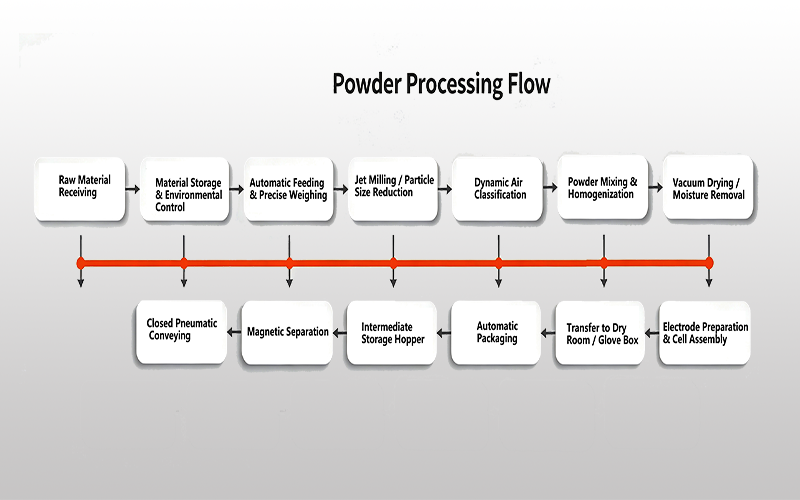
Advanced powder processing technologies, including jet milling, air classification, precision mixing, vacuum drying, and closed conveying, form the foundation for transforming laboratory battery materials into scalable industrial products.
In the next chapter, we will discuss:
Chapter 5:
Equipment Selection Guide for Solid-State Battery Powder Processing Systems
The chapter will focus on:
How engineers select jet mills for different battery materials
Fluidized-bed jet mill vs mechanical milling comparison
Mixer selection principles
Dryer selection strategy
Pilot line capacity planning
How SHJETER integrates individual machines into complete powder processing solutions