Chapter 3 Engineering Design of a Solid-State Battery Pilot Production Line
Process Flow, Critical Control Points and Equipment Selection
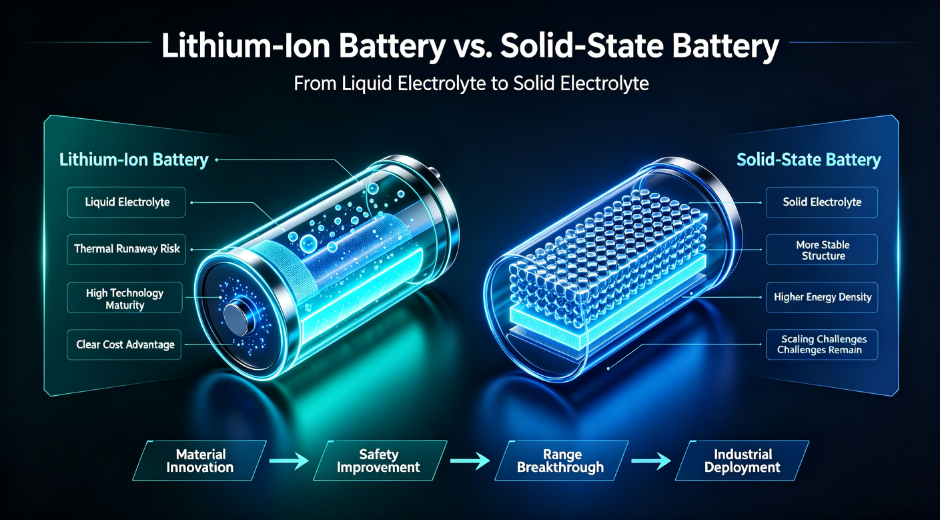
The successful commercialization of solid-state batteries depends not only on material innovation but also on the ability to manufacture those materials consistently, safely, and economically. While laboratory experiments typically focus on individual material properties, pilot production introduces an entirely different engineering challenge: integrating multiple processing stages into a stable and repeatable manufacturing system.
A pilot production line is more than a collection of machines connected in sequence. It is an integrated engineering platform designed to validate manufacturing processes, optimize operating parameters, and establish a reliable foundation for future scale-up. Every process stage influences the next, meaning that instability introduced upstream often becomes increasingly difficult to correct downstream.
For this reason, the engineering design of a solid-state battery pilot line should begin with material flow rather than equipment selection. The objective is to maintain consistent powder quality throughout the entire production process while minimizing contamination, moisture exposure, material loss, and process variability.
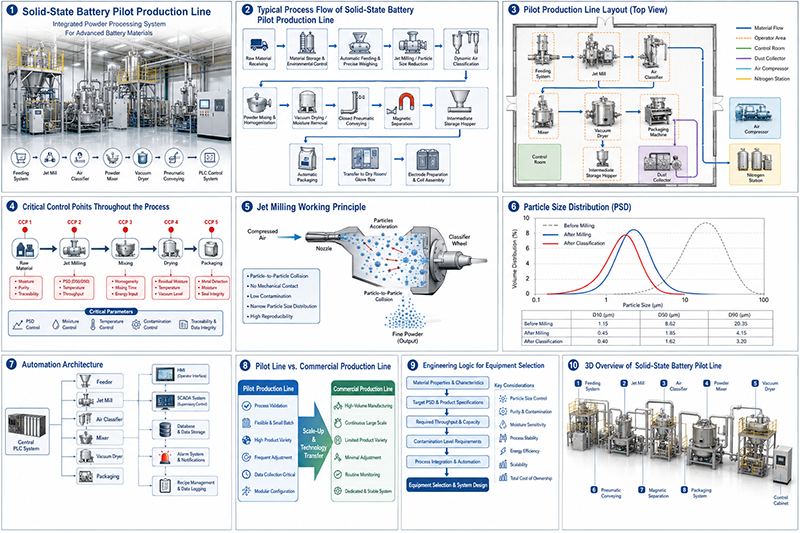
Typical Process Flow of a Solid-State Battery Pilot Production Line
Below is a representative powder processing workflow commonly adopted in pilot-scale manufacturing for advanced battery materials.
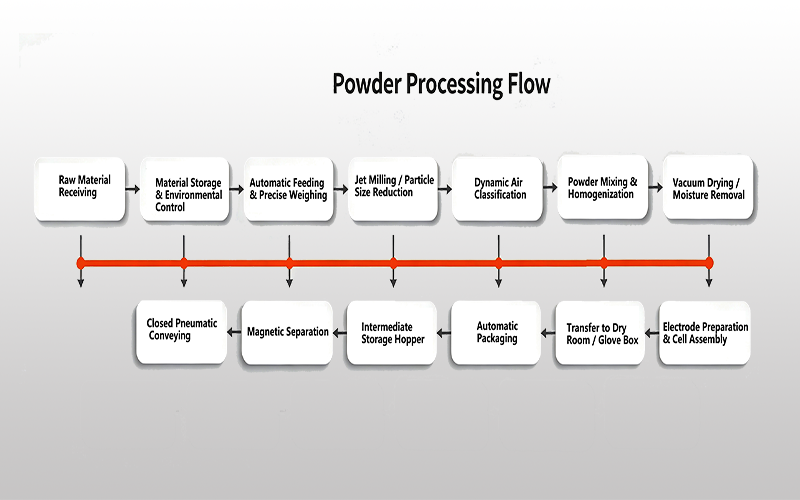
This workflow emphasizes powder consistency rather than production speed. Every process stage is designed to preserve the physical characteristics of sensitive battery materials while ensuring traceability and repeatability throughout pilot-scale manufacturing.
Stage 1 – Raw Material Receiving and Controlled Storage
Every successful production process begins with stable raw materials. Cathode powders, solid electrolytes, conductive additives, and binders should be stored under carefully controlled environmental conditions immediately after delivery.
Engineering Objectives
Prevent moisture absorption during storage.
Maintain material traceability.
Avoid cross-contamination between different material batches.
Preserve original particle characteristics before processing.
Key Control Parameters (KPIs)
| Parameter | Typical Target |
|---|---|
| Relative Humidity | < 1–5% (material-dependent) |
| Storage Temperature | Stable controlled environment |
| Batch Identification Accuracy | 100% |
| Cross Contamination | Zero tolerance |
Recommended Equipment
Sealed storage silos
Stainless steel containers
Nitrogen protection system
Environmental monitoring system
Stage 2 – Automatic Feeding and Precision Weighing
Consistent feeding forms the foundation of stable particle size control. Even a high-performance jet mill cannot compensate for fluctuating feed rates.
Modern pilot production lines therefore employ automated feeding systems capable of maintaining continuous and highly stable material supply.
Engineering Objectives
Constant feed rate
Accurate formulation
Fully enclosed operation
Reduced operator intervention
Typical Equipment
Loss-in-weight feeder
Screw feeder
Rotary valve
PLC-controlled feeding system
Key Performance Indicators
| Parameter | Typical Target |
|---|---|
| Feeding Accuracy | ±0.5–1% |
| Continuous Flow Stability | >99% |
| Material Leakage | None |
Stage 3 – Jet Milling: Precision Particle Size Engineering
Particle size engineering is often regarded as the heart of powder preparation for solid-state batteries.
Instead of relying on mechanical impact, jet milling uses high-velocity compressed gas to accelerate particles until they collide with one another. This particle-to-particle grinding mechanism minimizes mechanical contamination while producing an exceptionally narrow particle size distribution.
The objective is not merely to reduce particle size but to create powders with highly controlled PSD, improved dispersion behavior, and reproducible packing characteristics.
Engineering Objectives
Narrow particle size distribution
Low contamination risk
Minimal temperature rise
Reduced particle agglomeration
High reproducibility
Critical Process Parameters
| KPI | Importance |
|---|---|
| D50 | Product consistency |
| D90 | Coarse particle control |
| Product Temperature | Prevent material degradation |
| Throughput Stability | Continuous operation |
Recommended Equipment
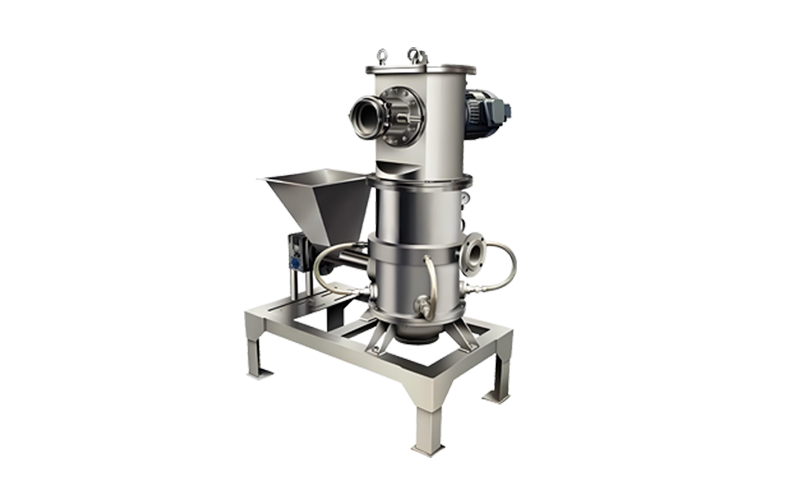
For pilot-scale production, fluidized-bed jet mills equipped with integrated dynamic classifiers are commonly selected because they provide simultaneous grinding and particle classification while allowing flexible adjustment of particle size during operation.
Stage 4 – Dynamic Air Classification
After milling, classification removes oversized particles and ensures that only powders meeting specification proceed to downstream processing.
Maintaining a narrow particle size distribution improves packing density, mixing behavior, and ultimately electrochemical consistency.
Engineering Objectives
Eliminate oversized particles
Maintain PSD consistency
Improve downstream mixing efficiency
Equipment
High-efficiency air classifier
Variable-speed classifier wheel
PLC-controlled airflow regulation
Stage 5 – Powder Mixing and Homogenization
Uniform powder distribution directly influences electrode performance.
A properly engineered mixing process ensures that active materials, solid electrolytes, conductive additives, and binders remain evenly dispersed throughout every production batch.
Mixing should achieve complete homogenization without damaging particle morphology.
Engineering Objectives
Uniform composition
Minimized segregation
Controlled mixing energy
Repeatable batch quality
Typical Equipment
Ploughshare mixer
Ribbon blender
High-efficiency powder mixer
Stage 6 – Vacuum Drying
Moisture control becomes increasingly important when processing moisture-sensitive solid electrolytes.
Vacuum drying removes residual moisture while avoiding excessive thermal exposure that could alter material properties.
Engineering Objectives
Low residual moisture
Stable powder characteristics
Reduced oxidation risk
Typical Equipment
Vacuum dryer
Nitrogen circulation system
Temperature-controlled drying chamber
Stage 7 – Closed Pneumatic Conveying
Manual material transfer introduces contamination risk, increases dust generation, and reduces process repeatability.
Closed pneumatic conveying systems transport powders between processing stages while maintaining environmental isolation.
Engineering Objectives
Closed material transfer
Reduced contamination
Improved production efficiency
Cleaner production environment
Stage 8 – Magnetic Separation and Final Packaging
Before packaging, powders typically pass through magnetic separation to remove potential ferrous contaminants generated during previous processing stages.
Finished materials are then transferred into sealed containers under controlled environmental conditions for storage or transport to electrode manufacturing.
Engineering Objectives
Metal contamination removal
Product traceability
Moisture protection
Safe packaging
Automation: The Invisible Equipment That Determines Line Stability
One of the most common misconceptions is that production capacity depends primarily on the performance of individual machines.
In reality, pilot production stability is largely determined by automation.
Modern pilot lines integrate PLC-based process control, recipe management, real-time monitoring, alarm systems, and production data recording into a unified control platform. These capabilities enable engineers to maintain consistent operating conditions, optimize process parameters, and collect reliable data for future scale-up.
Automation transforms individual machines into a coordinated manufacturing system.
Pilot Line vs. Commercial Production Line
Although both systems follow similar process principles, their engineering priorities differ significantly.
| Item | Pilot Production Line | Commercial Production Line |
|---|---|---|
| Primary Objective | Process validation | High-volume manufacturing |
| Capacity | Flexible, small batches | Continuous large-scale production |
| Process Adjustment | Frequent | Minimal |
| Product Variety | High | Limited |
| Data Collection | Critical | Routine monitoring |
| Equipment Configuration | Modular | Dedicated |
A pilot line is designed to generate engineering knowledge rather than maximize production output. Every experiment, parameter adjustment, and production batch contributes valuable information that supports future industrialization.
Engineering Insight: Design the Process Before Selecting the Equipment
One of the most common mistakes in pilot plant development is selecting equipment independently before establishing a complete process strategy.
Successful pilot production begins with defining material characteristics, product specifications, process objectives, and quality requirements. Equipment should then be selected as part of an integrated powder processing system rather than as isolated machines.
Only when feeding, milling, classification, mixing, drying, conveying, automation, and quality control are engineered as a unified process can manufacturers achieve the consistency required for successful scale-up.