How Does a Jet Mill Work? A Comprehensive Guide to Efficient Particle Size Reduction
In industries ranging from pharmaceuticals to advanced materials manufacturing, achieving precise particle size reduction is critical. One technology that stands out for its efficiency and versatility is the jet mill. This article dives deep into how a jet mill works, its advantages, and why it’s a preferred choice for ultrafine grinding.
What Is a Jet Mill?
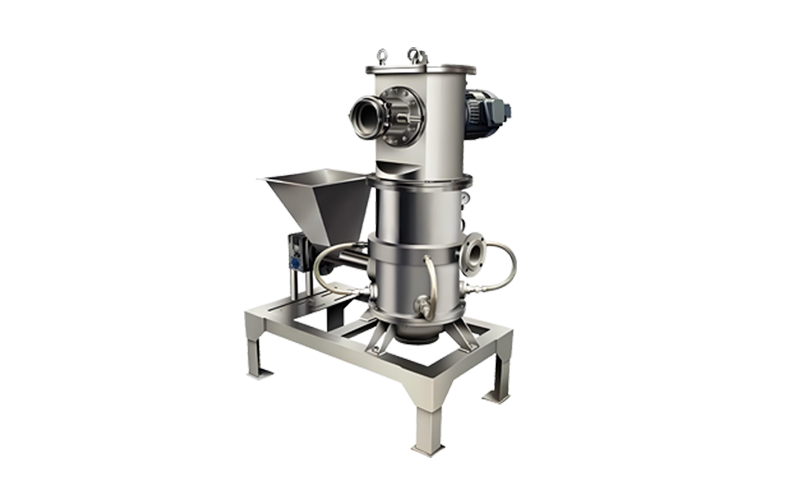
A jet mill, also known as a fluid energy mill, is a grinding device that uses compressed gas (typically air, nitrogen, or steam) to generate high-velocity collisions between particles. Unlike traditional mills that rely on mechanical force, jet mills achieve micron- and submicron-level particle sizes through kinetic energy, making them ideal for heat-sensitive or abrasive materials.
Key Components of a Jet Mill
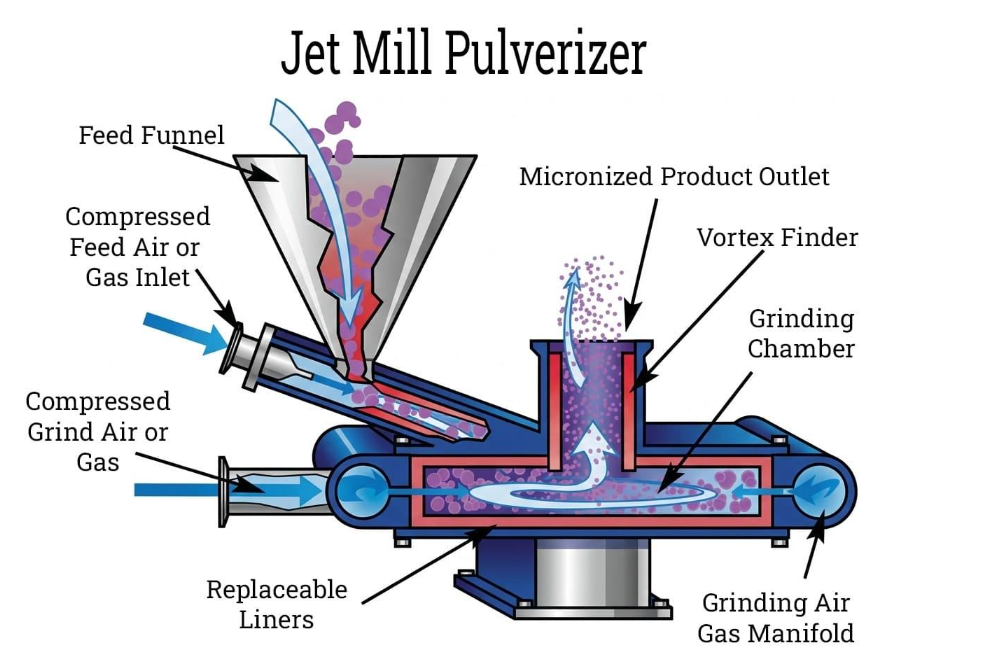
Understanding how a jet mill works begins with its core components:
Grinding Chamber: Where particle collisions occur.
Nozzles: High-pressure gas enters through strategically angled nozzles, creating a vortex.
Classifier: Separates fine particles from coarse ones, ensuring uniform output.
Cyclone or Filter: Collects the final product while recycling unused gas.
Step-by-Step Process: How a Jet Mill Works
1. Material Feeding
Raw material is fed into the grinding chamber via a screw feeder or pneumatic conveyor. The feed rate is controlled to optimize grinding efficiency.
2. Gas Acceleration
Compressed gas (air or inert gas) is injected at supersonic speeds (up to 1,000 m/s) through nozzles. This creates a high-velocity spiral flow, known as a “grinding vortex.”
3. Particle Collision and Fracture
As particles are drawn into the vortex, they collide with each other at extreme speeds. Kinetic energy transfer breaks larger particles into smaller ones without generating heat, preserving material integrity.
4. Classification and Separation
A built-in classifier (e.g., a dynamic wheel or static blades) segregates particles by size. Fine particles exit the chamber, while larger ones recycle for further grinding.
5. Product Collection
The final product is collected in a cyclone or filter system, ensuring minimal waste and maximum yield.
Why Jet Mills Excel: Key Advantages
Jet mills outperform traditional mills in several ways:
No Heat Generation: Ideal for heat-sensitive materials like APIs (Active Pharmaceutical Ingredients) or polymers.
Ultrafine Grinding: Achieves particles as small as 1-10 microns with narrow size distribution.
Zero Contamination: No moving parts contact the material, reducing wear and contamination risks.
Scalability: Suitable for both R&D labs and large-scale production.
Applications of Jet Mills
Jet mills are widely used in:
Pharmaceuticals: Grinding APIs without degrading potency.
Chemicals: Producing fine pigments, catalysts, and additives.
Food Industry: Creating ultra-fine powders for flavors and additives.
Advanced Materials: Manufacturing nanomaterials, ceramics, and composites.
Best Practices for Jet Mill Efficiency
Optimize Gas Pressure: Higher pressure improves grinding intensity but increases energy costs.
Control Feed Rate: Overloading reduces collision efficiency.
Regular Maintenance: Clean nozzles and classifiers to prevent blockages.
Conclusion
Jet mills revolutionize particle size reduction by harnessing kinetic energy for precise, contamination-free grinding. Their ability to handle heat-sensitive and abrasive materials makes them indispensable in high-tech industries.
For businesses seeking ultrafine grinding solutions, investing in jet mill technology ensures quality, efficiency, and scalability—key drivers of competitive advantage.