Jet Mill for Pharmaceutical Powder: 7 Proven Advantages for Contamination-Free Micronization
Jet Mill for Pharmaceutical Powder: 7 Proven Advantages for Contamination-Free Micronization
Meta Description: Discover how a jet mill for pharmaceutical powder delivers contamination-free micronization, precise particle size control, and GMP-ready performance. Learn expert insights for API processing.
Introduction to Jet Mill for Pharmaceutical Powder
In modern pharmaceutical manufacturing, achieving precise particle size and absolute purity is not optional—it is essential. The use of a jet mill for pharmaceutical powder has become a standard solution for micronizing Active Pharmaceutical Ingredients (APIs) while maintaining strict quality and regulatory requirements.
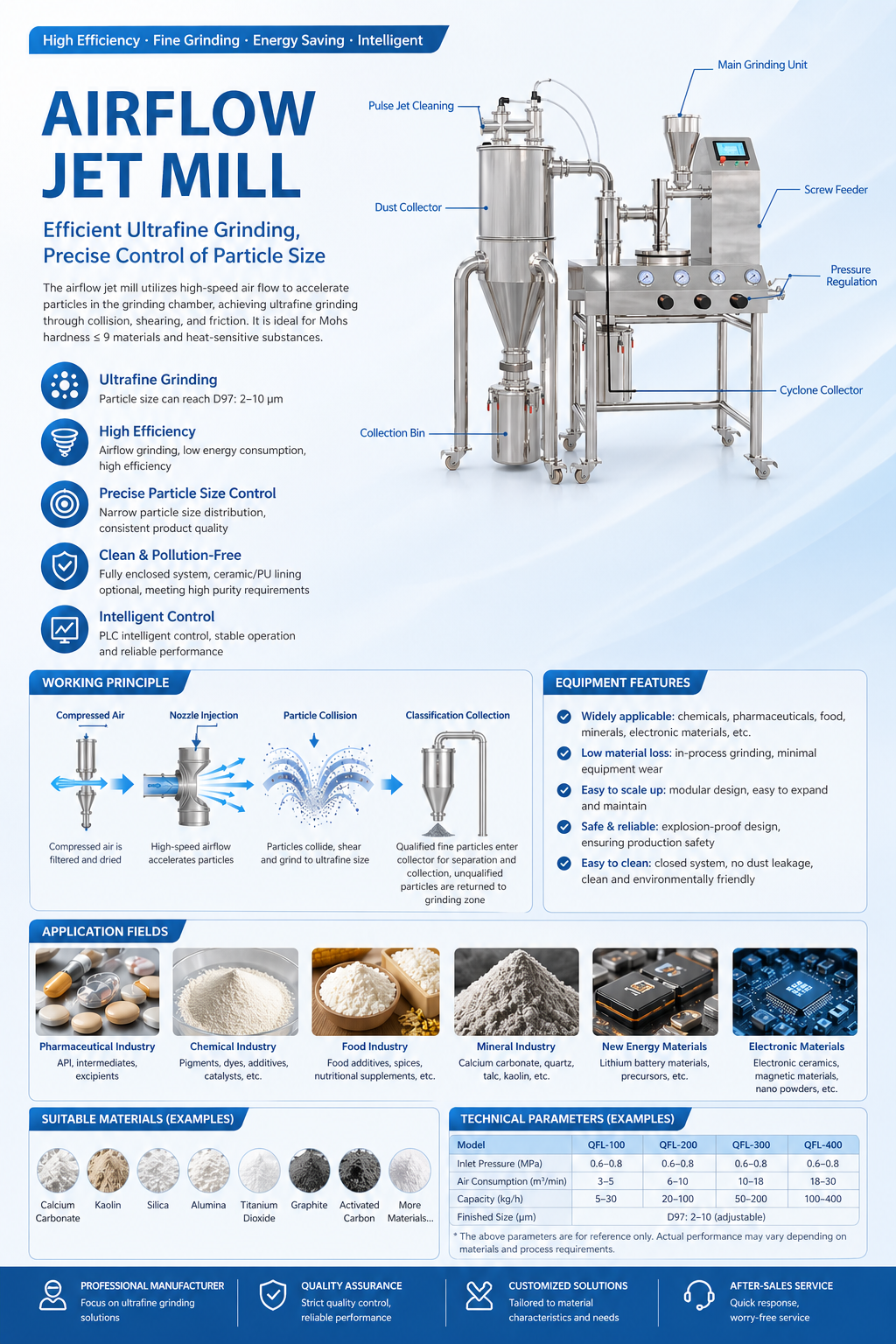
Unlike traditional grinding systems, jet milling relies on high-velocity compressed air or gas to induce particle-to-particle collisions. This process eliminates mechanical contact, making it ideal for applications where contamination must be avoided at all costs.
For pharmaceutical engineers, this technology offers a reliable pathway to achieve consistent particle size distribution, improved drug bioavailability, and compliance with GMP standards.
Why Jet Mill for Pharmaceutical Powder Is Critical in API Processing
Pharmaceutical powders demand extremely tight control over both particle size and purity. Even trace contamination or slight deviations in particle distribution can impact drug performance.
Contamination-Free Micronization
Jet mills operate without grinding media. This means there is no risk of metal abrasion or foreign particle introduction, making them highly suitable for sensitive APIs.
High Precision Particle Size Control
Jet milling can consistently achieve particle sizes in the range of 1–10 microns. This level of control is critical for enhancing dissolution rates and bioavailability.
Low-Temperature Grinding
Heat-sensitive materials benefit from the cooling effect of expanding gas streams, which prevents thermal degradation during the milling process.
GMP Compliance and Cleanability
Pharmaceutical-grade jet mills are designed with smooth internal surfaces, no dead zones, and easy disassembly features. This ensures effective cleaning, faster validation, and reduced downtime.
How Jet Milling Technology Works
Understanding how a jet mill operates helps engineers optimize performance and avoid common pitfalls.
Working Principle
Compressed air or inert gas is accelerated through nozzles into a grinding chamber. The resulting high-speed jets create a turbulent zone where particles collide and fracture into finer sizes.
Internal Classification
In advanced systems, a built-in classifier separates fine particles from coarse ones. Only particles that meet the desired size exit the system, ensuring uniform distribution.
Key Process Parameters for Particle Size Control
Precise particle size control is not automatic—it depends on careful adjustment of process variables.
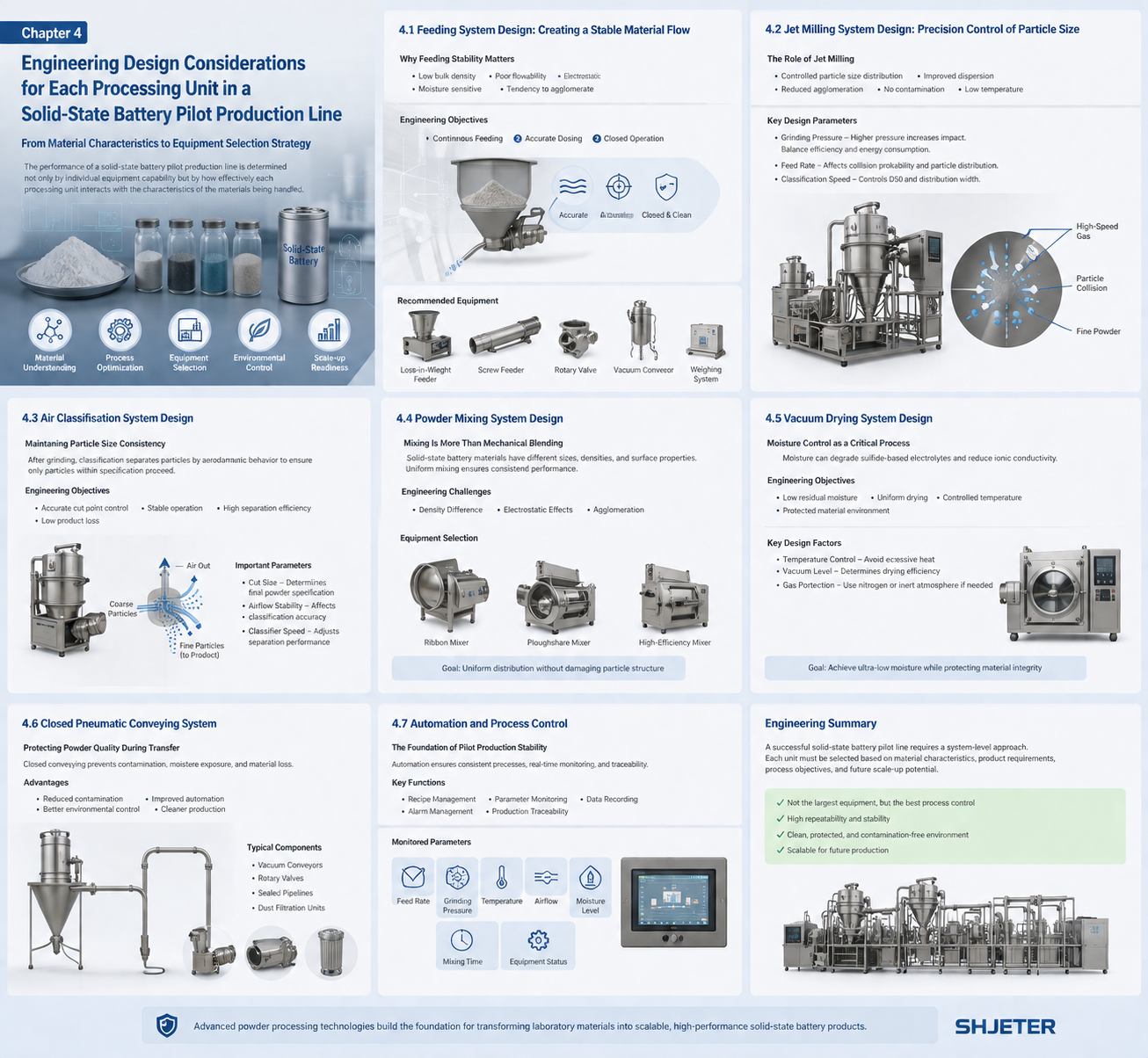
Grinding Pressure
Higher pressure increases particle velocity, leading to finer particles. However, excessive pressure may increase energy consumption.
Feed Rate
A balanced feed rate ensures efficient grinding. Overfeeding reduces collision efficiency, while underfeeding wastes energy.
Classifier Speed
The classifier determines the final particle cut size. Higher speeds result in finer powders, while lower speeds allow coarser particles to pass.
Engineer’s Insight
In pharmaceutical production, Design of Experiments (DOE) is commonly used to establish a stable operating window. This ensures consistent particle size distribution across batches, which is essential for regulatory compliance.
Fluidized Bed Jet Mill vs Spiral Jet Mill
Choosing the right type of jet mill is crucial for pharmaceutical applications.
Spiral Jet Mill
Simple design
Suitable for small-scale or laboratory use
Limited control over particle distribution
Fluidized Bed Jet Mill
Advanced classification system
Superior particle size control
Ideal for large-scale pharmaceutical production
Recommendation
For API micronization, fluidized bed jet mills are generally preferred due to their ability to deliver consistent and reproducible results.
Ensuring a Contamination-Free Jet Milling Process
Contamination control is one of the most critical aspects of pharmaceutical processing.
Key Design Features
Ceramic or polymer lining to eliminate metal contact
No dead zone structure to prevent material accumulation
Tool-free disassembly for fast cleaning
Sealed system design to avoid cross-contamination
Engineer’s Perspective
In GMP environments, cleaning validation can be a major bottleneck. Equipment with complex internal geometries increases validation time and risk. A no-dead-zone design significantly simplifies compliance and reduces operational costs.
Energy Efficiency and Compact System Design
Energy consumption and facility space are often overlooked, yet they play a significant role in long-term operations.
Energy Efficiency Benefits
Optimized airflow reduces compressed gas consumption
Lower operational costs over time
Compact Footprint
Fits easily into cleanroom environments
Simplifies integration into existing production lines
Common Jet Milling Challenges and Solutions
Inconsistent Particle Size
Cause: Fluctuating pressure or unstable feed rate
Solution: Stabilize process parameters and monitor system pressure
Low Throughput
Cause: Classifier speed set too high
Solution: Adjust classifier settings to balance fineness and output
Temperature Rise
Cause: High energy input or dense feed
Solution: Increase airflow or reduce feed rate
Difficult Cleaning
Cause: Poor equipment design
Solution: Use systems with smooth surfaces and quick disassembly features
Real-World Application: API Micronization Case Study
A pharmaceutical manufacturer faced multiple issues during API production:
Wide particle size distribution
Metal contamination
Long cleaning cycles
Solution Implemented
Switched to a contamination-free jet mill
Optimized classifier speed and pressure
Adopted a quick-disassembly design
Results Achieved
Stable D50 at 3 microns
Complete elimination of contamination
50% reduction in cleaning time
FAQs: Jet Mill for Pharmaceutical Powder
1. Can jet mills achieve nano-sized particles?
Jet mills typically achieve particles down to 1 micron. Nano-scale requires specialized processes.
2. Are jet mills suitable for heat-sensitive materials?
Yes, the cooling effect of gas expansion makes them ideal for temperature-sensitive APIs.
3. How can cross-contamination be prevented?
By using sealed systems, smooth internal surfaces, and easy-to-clean designs.
4. Do jet mills meet GMP requirements?
Yes, when designed with proper materials and cleanability features.
5. What is the maintenance requirement?
Low, as there are no moving grinding parts subject to wear.
6. How to choose the right jet mill model?
Selection depends on particle size requirements, production capacity, and material characteristics.
Conclusion: Optimizing Pharmaceutical Production with Jet Milling
Selecting the right jet mill for pharmaceutical powder is a strategic decision that directly impacts product quality, operational efficiency, and regulatory compliance.
A system designed with contamination-free operation, high precision control, easy cleaning, and energy efficiency can significantly enhance pharmaceutical manufacturing performance.
For companies aiming to improve API micronization while reducing operational risks, investing in an advanced jet milling solution is not just beneficial—it is essential.
Get Expert Support
Looking to optimize your pharmaceutical micronization process?
Request a free powder testing service
Consult with experienced engineers for customized solutions
Explore advanced jet mill systems tailored for GMP environments